Detection, Prevention and Repair of Sub-Surface Corrosion in Overhead Line Supports, Anchors and Foundations
Corrosion is a major concern in engineering due to its serious effects on structures. For buried steel components of OHL foundations, the risk of corrosion is even more significant due to the wide variability in soil chemistry, humidity and conductivity. This relevant TB addresses scenarios such as steel corrosion in soil, in concrete, and above-ground foundations. It also covers corrosion inspection and detection methods, as well as refurbishment and repair technologies.
Members
Convenor (NL)
R. Meijers
Secretary (IN)
C. Johnson
J.B. da Silva (BR), J. Calitz (ZA), D. Dukhan (ZA), G. Florea (RO), G. Ford (AU), A. Haldar (CA), S. Labocha (PL), R. Ladeira (PO), D. Mondière (FR), J. Parasian (US), A. Ruffier (BR)
Corresponding Members
M.C. de Araùjo, B. Guidicelli (FR), M. Goretti (IT), L. Laurentiu (RO), F. Lehretz (DE), A. Mogilevski (CA), D. Pareira (FR), S. Ramadhin (ZA), K.V. Singh Pundir (IN), K. Yamamoto (JP)
Introduction
Corrosion of metallic components in overhead line (OHL) infrastructure remains a major challenge. Sub-surface deterioration often progresses unnoticed until structural effects become visible. Underground environments vary significantly in soil chemistry, moisture, resistivity, aeration, and microbiological activity, resulting in diverse corrosion mechanisms. Figure 1 illustrates typical examples of buried steel corrosion.
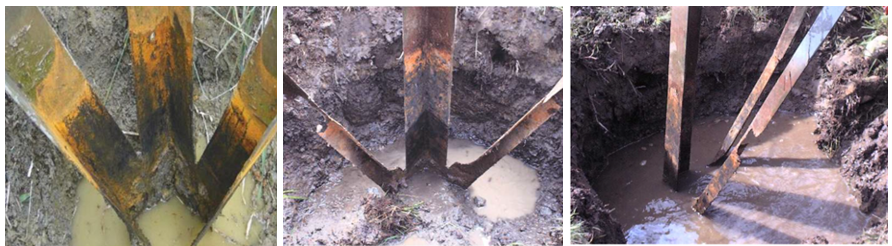
Figure 1 - Examples of Buried Steel Foundation Corrosion
This document summarises the main corrosion mechanisms affecting direct-embedded steel and concrete foundations, along with prevention, inspection and repair practices aligned with CIGRE guidance. Increasing field observations indicate that ageing infrastructure and higher utilisation reinforce the need for harmonised assessments and long-term mitigation strategies.
Corrosion Mechanisms Affecting Direct Embedded Steel in Soil
Direct‑embedded steel foundations operate in aggressive and non‑uniform soils, where corrosion behaviour is driven by multiple interacting processes influenced by soil properties, electrochemical gradients and nearby infrastructure.
Soil characteristics such as resistivity, permeability, ion concentration, pH, redox potential, moisture and microbial activity vary significantly with location and depth, making corrosion inherently multifactorial. Long‑term exposure tests show that carbon steel, galvanised steel and weathering steel exhibit different mass‑loss profiles under identical conditions (Figure 2).
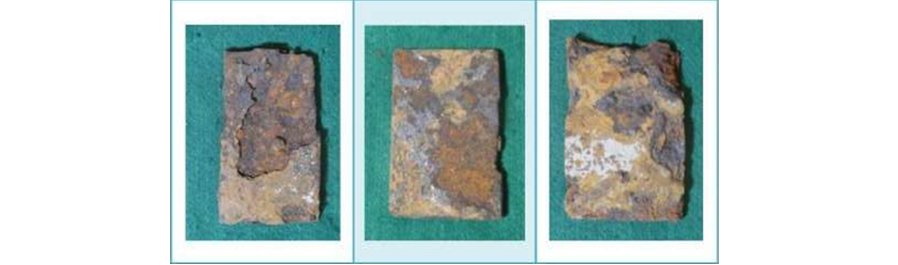
Figure 2 - Visual Appearance of Different Materials (Carbon, Galvanized and Weathering Steel [Left to Right])
Stray-current corrosion is a major accelerator of deterioration. Unintended DC currents, often originating from Impressed Current Cathodic Protection (ICCP) systems on nearby pipelines or industrial assets, can discharge onto buried steel. Because these discharges concentrate on small areas, even low current densities can cause severe localised attack, particularly near transport corridors or industrial zones where Cathodic Protection (CP) systems are widespread.
Galvanic corrosion is another important mechanism, occurring when steel is electrically coupled with more noble metals such as copper. Grounding systems commonly include copper conductors, and such connections can make steel the anodic component, causing preferential corrosion even in moderately aggressive soils.
Operational feedback from several utilities indicates that these mechanisms often occur simultaneously and that land use changes can accelerate deterioration in foundations that were previously stable.
Anchored tower structures in OHL systems offer economic advantages, but anchor-shaft corrosion has proven a critical vulnerability. Thick zinc galvanisation provides limited protection in oxygen-poor soils, where zinc becomes unstable and degrades rapidly. As a result, anchor rods may lose significant cross-section, and the steel hook embedded in the concrete plate may also corrode. Failure under wind or ice loading can lead to tower collapse and potentially trigger progressive failure of adjacent towers, particularly suspension-guyed types, as illustrated in Figures 3 and 4.
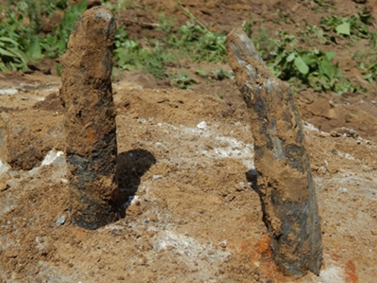
Figure 3 - Corroded anchor shaft hook after 49 years in Romania
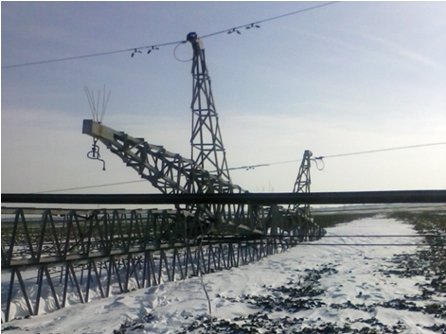
Figure 4 - Collapsed guyed tower of a 400 kV single circuit line in Romania
Prevention of Corrosion for Steel in Soil
Effective corrosion prevention requires a combination of complementary mitigation techniques. No single method provides comprehensive protection in all soil conditions, so utilities generally apply multi-layered measures.
A basic measure is to add steel thickness to serve as a corrosion allowance. This accommodates long-term deterioration by incorporating sacrificial material. It is practical for standardised components but is rarely used as a standalone measure in aggressive soils.
Physical barriers are the primary protection method. Coatings or casings separate the steel from the soil environment, reducing exposure to moisture and corrosive ions. Polymeric coatings, particularly epoxy systems, are widely adopted due to their high chemical resistance and long‑term adhesion. Multi‑layer systems incorporating primers and abrasion‑resistant topcoats are used where environmental exposure is significant or installation damage is likely. Examples of coated foundations in typical applications are presented in Figure 5.
ELECTRA, is the digital magazine of CIGRE, you can obtain access as part of a CIGRE membership. Find out more about joining options here.
Other Technical Brochures