Energy Sectors Integration and Impact on Power Grids
Climate change poses a significant global challenge, requiring urgent and stringent measures to limit global temperature increases to 1.5°C, as stipulated in the Paris Agreement. In response to this imperative, the global energy sector is undergoing a progressive transformation towards low-carbon and potentially zero-carbon systems. This transition is not merely achievable through the integration of renewable energy into power systems; it necessitates a comprehensive coupling of various energy sectors to achieve carbon reduction, ensure grid reliability, and enhance efficiency.
Members
Convenor (CN)
N. ZHANG
Secretary (CN)
Kangping LI
Jiakun FANG (CN), Chen FANG (CN), Gülcan KOCA (TR), Dan WANG (CN), Alfredo CARDENAS (CL), Deepak RAMASUBRAMANIAN (US), Polly OSBORNE (UK), Mehtap ALPER SAĞLAM (TR), Spyros SKARVELIS-KAZAKOS (UK), Graeme HAWKER (UK), Fabio RIVA (IT), Christian SCHAEFER (AU), Laura LÓPEZ (SP), Jarrad G. WRIGHT (ZA), J. Charles SMITH (US), Moein MOEINI-AGHTAIE (IR), Mo CLOONAN (IE), Sara HAGHIFAM (FI), Hossein FARZIN (IR), Birgitte BAK-JENSEN (DK), Thomas BROUHARD (FR)
Introduction
Historically, energy sectors such as electricity, gas, and heating/cooling have functioned independently. However, the integration of energy sectors (ESI) has emerged as a critical strategy to facilitate this transition. ESI promotes synergy among these sectors, thereby advancing decarbonization efforts and significantly reducing CO2 emissions. The primary drivers of ESI are threefold:
- It contributes to carbon reduction by integrating renewable energy sources to replace or complement fossil fuels, thereby diminishing overall emissions.
- ESI enhances grid reliability by providing multiple energy pathways and enabling partial system operation during disruptions.
- It improves economic and energy efficiency by reducing capital expenditures on infrastructure and optimizing energy utilization, particularly with intermittent renewable sources.
This report delves into the technical, business, economic, and regulatory issues associated with ESI and evaluates cutting-edge research from various countries. The TB aims to bridge the gap between academic studies and ESI industry practices and identify key issues that require future attention. With 23 members from 14 countries, WG C1.47 conducted a comprehensive global investigation to determine the current state of ESI and its effects on power grids. The scope of this TB encompasses the following:
- Identifying the technical, business, and institutional challenges and benefits of energy sector integration at the transmission grid level.
- Reviewing methodologies and technologies related to modeling, operation, market analysis, and planning for multiregion-level ESI.
- Summarizing the lessons learned and best practices in energy sector integration.
- Proposing policy and market regulation suggestions to advance ESI at the transmission grid level.
Structure of TB
Chapter 1: The opening chapter includes the background, definition, scope, and aim of the TB.
Chapter 2: This chapter provides a comprehensive literature review of energy sector integration. In chapter 2.1, energy conversion technologies for energy sector integration are summarized from the power-to-X (including power-to-gas, power-to-heat, power-to-cooling, and power-to-transport) and gas-to-X (including gas-to-power, gas-to-heat, combined cooling heat and power plants, and combined heat and power plants) perspectives. Chapter 2.2 introduces the current status of energy sector integration in different countries.
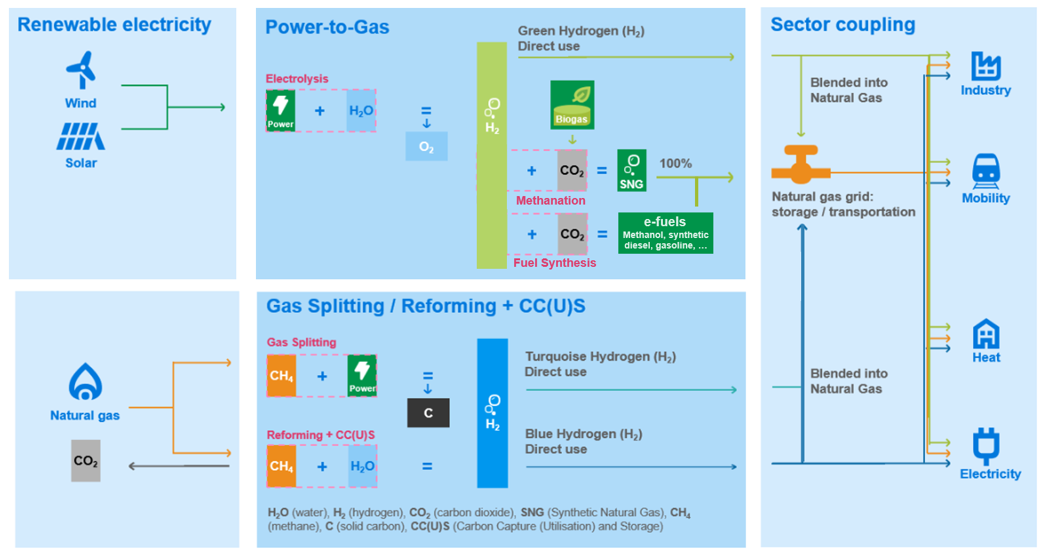
Figure 1 - Exemplary power-to-gas process chain
Chapter 3: This chapter analyzes the impact of energy sector integration on the power transmission system. Chapter 3.1 examines the opportunities and challenges for power transmission systems resulting from the integration of multiple energy sectors from various perspectives. Chapter 3.2 discusses the implications for transmission system planning, and chapter 3.3 addresses the impacts on transmission system operation. Chapter 3.4 investigates the effects from a multienergy coupling market perspective, taking into account privacy-preserving issues.
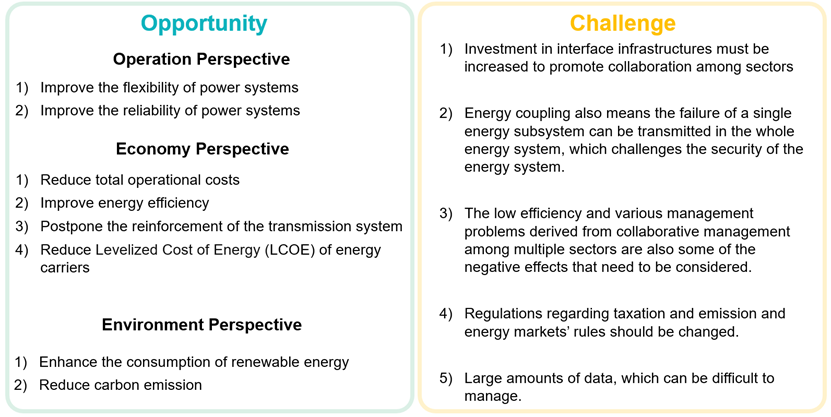
Figure 2 - Opportunities and challenges
Chapter 4: This chapter introduces a universal modeling method for multienergy systems from two distinct yet interconnected levels. The first level is the energy hub layer. At this level, we focus on developing models that describe the processes for converting between different forms of energy within a hub. The second level is the network layer. Here, the objective is to model the interconnections and coupling between different energy hubs. Following chapter 4.1 on two-level modeling, chapter 4.2 presents a general multienergy system planning method that addresses the strategic design and optimization of these systems for future development. Chapter 4.3 introduces a method for simulating the operation of multienergy systems, including district-level operation, regional-level operation, and multiregional-level operation. Finally, chapter 4.4 discusses how multienergy systems can participate in market clearing and bidding processes, offering a comprehensive view of how these systems interact with energy markets to ensure efficient and competitive operation.
Chapter 5: This chapter reviews software designed for power system planning that considers energy system coupling in power system planning, including EnergyPRO, EnergyPLAN, PLEXOS, GTEP, IESP, Calliope, SAint, Artelys Crystal Super Grid, and PowSyBl. Notably, most software is not designed especially for power system planning and is...
ELECTRA, is the digital magazine of CIGRE, you can obtain access as part of a CIGRE membership. Find out more about joining options here.
Other Technical Brochures