From Pit Stop to Power Grid
What the Energy Industry Can Learn from Formula 1
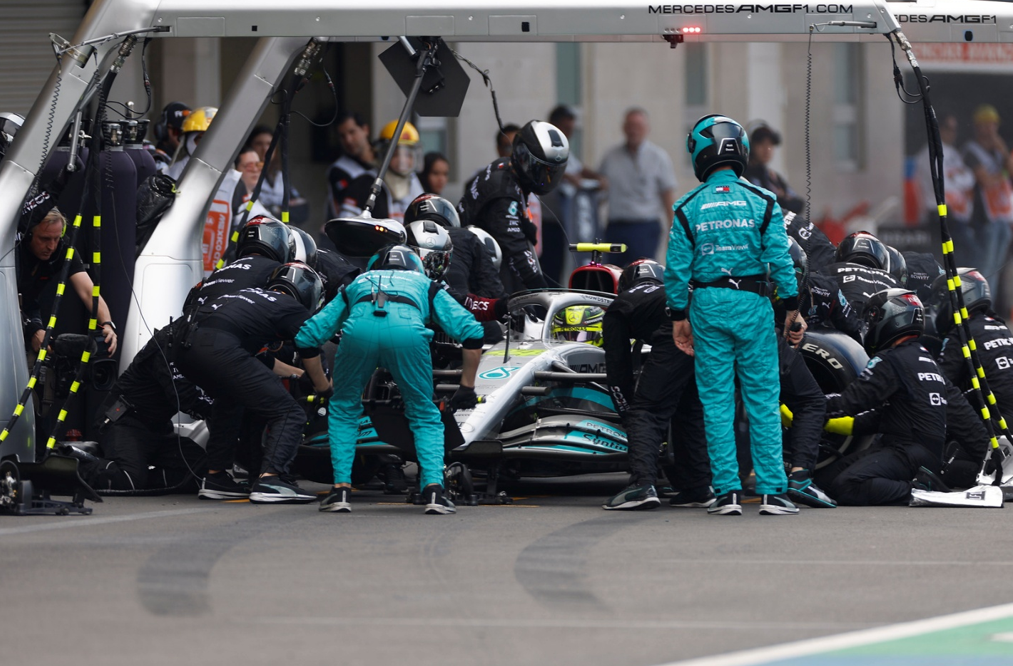
Photo credit: Mercedes-AMG Petronas Formula 1 Team/LAT images
By Adam Middleton, Nicole Bearne and Jay R. Weiser
Formula 1 is a billion-dollar enterprise built around eleven outstanding organisations: the teams. Our premise is simple — other industries, including energy and grid, can learn from these teams about leadership, organisation and "Future Readiness."
This article follows earlier work by Adam Middleton and Jay Weiser, with Sabrina Mercer, in ELECTRA (August 2026), on the capabilities that organisations need to become “future-ready”.
Here we ask the next question: how are those capabilities exercised under pressure? F1 offers a useful model — not because teams predict every turn, but because they continuously sense, interpret, learn, decide, adapt and execute as conditions change.
We are indebted to Nicole Bearne for her insight into organisation and performance within F1.
Even the fastest organisations need pit stops
Boardrooms across the energy sector often reach for the same phrase: "It's like changing the tyres while the car is still moving." It captures the pressure on today's network and grid businesses, equipment manufacturers, system operators and their advisers, expected to transform while running at full performance amid rising demand, evolving regulation, tight supply chains and shifting technology.
The metaphor deserves closer scrutiny, because F1 offers something more precise.
“A pit stop is mandatory, but it is also central to strategy — a deliberately engineered intervention, built in from the outset rather than bolted on when things go wrong”
Throughout a race, data streams continuously from the car to strategists on the pit wall and back at base. When the decision is made to bring the car in for a pit stop, that flow of information turns into a precisely coordinated intervention. Over twenty specialist mechanics know exactly what to do, in what order, with what tolerance for error. Decisions are made in seconds; execution is trained precision, not improvisation. The car returns to the track better prepared: fresh tyres, an updated strategy, a recalibrated understanding of the race.
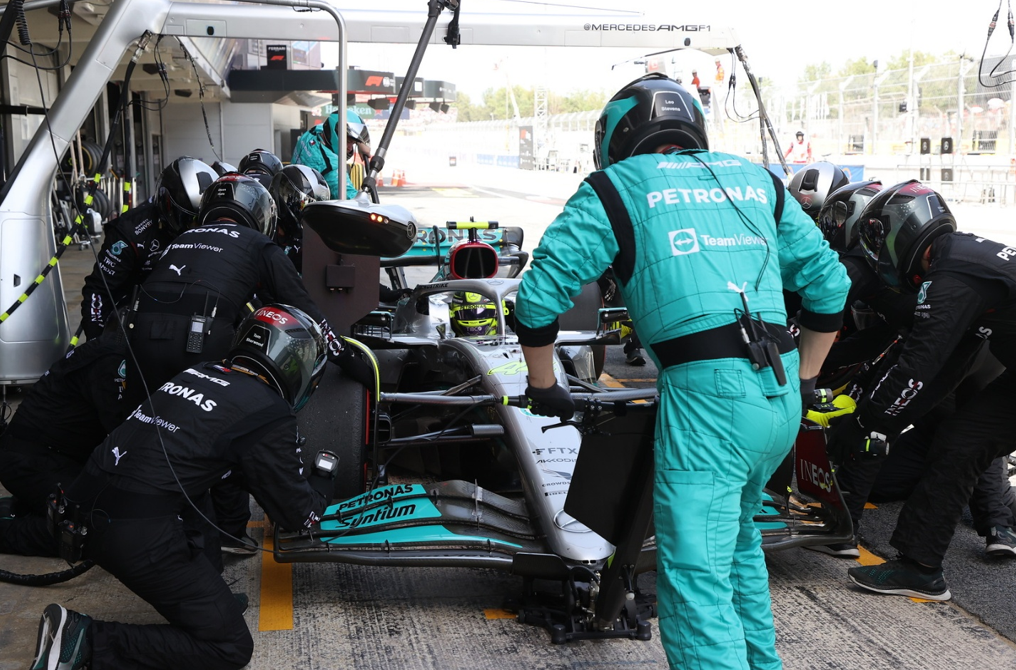
Photo Credit: Mercedes-AMG Petronas Formula 1 Team/Wolfgang Wilhelm
The pit stop is the visible intervention; the capability behind it is continuous — long before the car enters the pit lane, the team is sensing, interpreting and preparing to act. Even with extensive data and simulation, F1 teams know they cannot predict everything: weather changes, rivals behave unexpectedly, safety cars intervene, components fail.
“The pit stop lets a team respond to the race as it actually is, rather than continuing a strategy built for conditions that no longer hold”
The energy sector runs an equally demanding race — measured in price-control periods, investment cycles and technology transitions spanning a decade or more. Yet the instinct when conditions get difficult is often to keep the car on the track and hope the tyres hold.
"We're too busy" inverts the critical question
Ask any executive team whether it has time to step back and realign, and the answer is familiar: "We're too busy." The pressures are real — grid connection queues, supply chains, workforce shortages, price reviews, and the looming retirement of much of the Western world’s energy workforce.
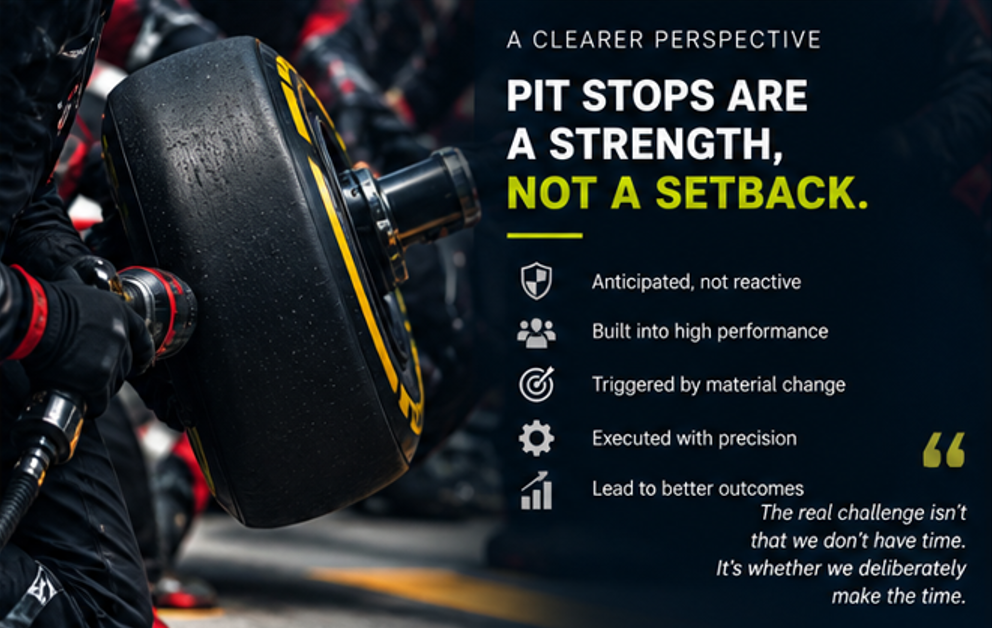
But this framing gets the question backwards. F1 teams, operating under the most intense, time-pressured competition in global sport, deliberately build time into their strategies to assess and adjust mid-race. After every race, structured debriefs turn experience into organisational learning.
“When information moves quickly, learning moves quickly”
Speed alone is not enough, though. Signals must be surfaced, connected and interpreted across boundaries. One part of a business may see a customer shift; another, a supply-chain constraint; another, an emerging technology or workforce risk. Individually, none may look decisive. Together, they tell a different story. Can a capital-intensive, multi-decade infrastructure sector afford not to create equivalent time to sense, learn, realign and adapt? A leadership pit stop is not time away from the work — it is part of the work, strengthening the capabilities that sustain performance over the long haul.
The questions worth asking at the leadership pit wall
F1's pit wall constantly asks a small set of disciplined questions. Similar ones should run through energy-sector leadership conversations:
Are we seeing changes early enough?
Signals from connection queues, procurement pipelines, or a client's shifting investment posture become a crisis rather than a strategic input if spotted too late.
What are we learning from performance and experience?
Every project, price control cycle, search or investor conversation generates data; the question is whether the organisation converts it into insight or simply moves on.
Have conditions changed since we made our decisions?
Assumptions made eighteen months ago about supply chains, rates, technology or competitors may no longer hold. A pit stop tests them deliberately, rather than discovering their obsolescence under pressure. For consequential decisions, identify at the point of decision which assumptions matter most, and what should trigger reconsideration.
Do our priorities, resources and assumptions still align?
Realignment does not mean the original decision was wrong — the conditions it depended on may simply have changed.
What needs to change before we accelerate again?
Sometimes nothing. More often it is something specific: a resourcing gap, a stakeholder relationship, a capability the organisation has been meaning to build.
Knowing when to stop — and when to stay on track
The real lesson goes beyond the stop itself. A team does not pit on a fixed schedule; it decides when to come in, what to change, and whether conditions justify stopping at all. Getting that call wrong, in either direction, can cost the race. The discipline is not recognising that something has changed — conditions always are — but judging whether the change is material enough to challenge a governing assumption.
“Reacting to every signal creates churn; ignoring the consequential ones creates drift”
That judgement depends on information flowing continuously — reaching the right people quickly, and being understood, debated or challenged. A leadership pit stop needs the same flow: information moving upward as well as downward, people confident enough to raise concerns, and insight from those closest to the work being heard. Without it, leaders risk reassessing the future using an outdated view of the present.
A pit stop is useful only when the team has the judgement to decide what genuinely needs to change — and the discipline to get back into the race quickly. We call this Disciplined Adaptability™: remaining anchored enough to execute while staying adaptive enough to change when conditions warrant it.
“A pit stop creates value only when it improves the quality of what happens next.”
Future-ready leadership is a discipline, not an event
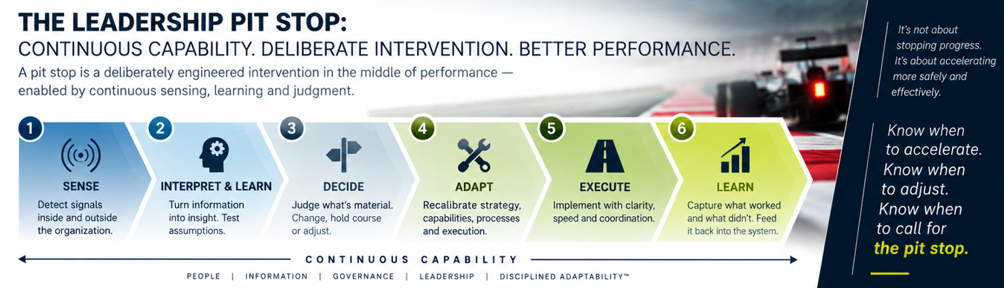
Future-ready organisations do not simply move fast. They build the capability to sense, interpret, learn, decide, adapt and execute as conditions change — repeatedly, and before circumstances force them to. Sometimes that means calling for the pit stop precisely when everything appears to be going well.
Execution does not end the cycle: it generates new signals that feed back into how the organisation senses, decides and responds next time — Sense → Interpret/Learn → Decide → Adapt → Execute → Learn → Sense.
For an industry renewing the infrastructure behind the energy transition, this matters enormously. The organisations that lead the next decade of grid expansion, equipment innovation and cross-border investment will not be the ones that never stop, but those that know precisely when and how to stop — briefly, deliberately, with precision — before accelerating again.
“Data alone does not create Future Readiness. People must notice what matters, connect what they are seeing and exercise judgment about what it means.”
The real challenge isn't whether leadership teams have the time — it's whether they deliberately make it. When did your team last take a genuine pit stop: not another meeting, but deliberate time to learn, challenge assumptions and revalidate important decisions? What did you change, or decide not to change, as a result?
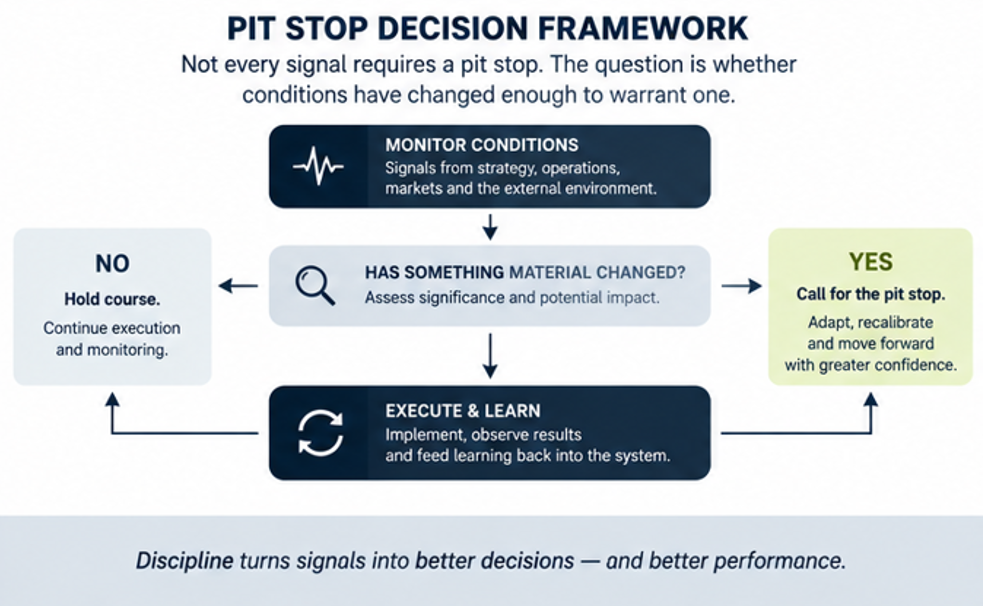
The organisations best prepared for uncertainty will not be those that predict every turn, but those that recognise sooner when conditions have materially changed, learn faster, and adapt while they still have choices. F1 teams may be among the most future-ready organisations on Earth. There is much we can learn from them.
“Box. Box. Box.”
About the authors

Adam Middleton is Director of EnergetIQ Advisory Limited and a Member of the Executive Committee of CIGRE UK. A former VP of Siemens Energy, he advises leadership teams and boards across the UK and European energy sector on strategy, executive intelligence and business development.

Nicole Bearne is Founder and Director of The Comms Exchange and former Head of Internal Communications at the Mercedes-AMG Petronas Formula One team, where she worked at the heart of one of the world's most high-performing organizations. Today, she works with leaders and teams to strengthen alignment, communication and trust to enable high performance.

Jay R. Weiser is Chief Catalyst and Navigator at Jay Weiser Consulting. He advises, guides, and enables boards and leadership teams to realize more of their potential value by improving their ability to sense, adapt, and perform under sustained pressure.
Suggested content