18th DEMSEE Congress Annual Report
The 18th DEMSEE Annual Congress – Deregulated Electricity Market Issues in South-Eastern Europe – was held in Belgrade, Serbia, on 22–23 June 2026. The Congress returned to Belgrade after the DEMSEE event previously held in the city in 2009, bringing together experts from transmission system operators, regional coordination centres, academia, industry, consulting companies, and other organizations active in the electricity sector.
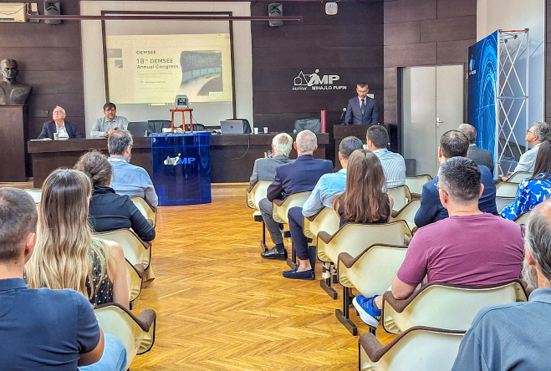
Opening DEMSEE 2026 by Igor Bundalo
Belgrade, Serbia
22–23 June 2026
By Thales M. PAPAZOGLOU (GR), DEMSEE CONGRESS Founder,
and Igor BUNDALO (SR) DEMSEE CONGRESS Chairman
The Congress was opened by Igor Bundalo (Institute Mihajlo Pupin), Chairman of the 18th DEMSEE Congress, who welcomed the participants and emphasized the importance of DEMSEE as a regional platform for the exchange of knowledge, operational experience, and new ideas in power system operation and electricity market development.
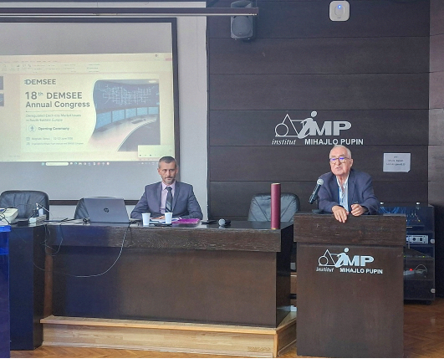
Following his address, Professor Thales M. Papazoglou, Founder of the DEMSEE Congress, addressed the participants and reflected on the importance of continuity of the DEMSEE Congress, highlighting its long-standing role in fostering cooperation, knowledge sharing, and sustained development of the regional power engineering community.
The focus of the 18th DEMSEE Congress reflected the ongoing transformation of the electricity sector in South-Eastern Europe and across Europe. Particular attention was given to the increasing complexity of power system operation, the integration of renewable energy sources, regional coordination between TSOs, DSOs and RCCs, blackout prevention, digital transformation, artificial intelligence, engineering-grade digital twins, and the evolution of control centres.
The keynote programme addressed several important and timely topics. The first keynote lecture, delivered by Valentina Loisi from Neara, was entitled “Engineering-Grade Digital Twins: Unlocking Capacity, Resilience, and Smarter Investment.” The presentation showed how engineering-validated digital twins can support utilities in revealing latent network capacity, improving resilience, reducing unnecessary capital expenditure, and testing operational and investment scenarios before mobilising field crews. The lecture highlighted the practical use of LiDAR, GIS, asset data, terrain, vegetation, and environmental loading in creating physics-based 3D network models.
The second keynote lecture, delivered by Professor Mileta Žarković from the University of Belgrade, School of Electrical Engineering, focused on applied artificial intelligence in power systems. The presentation covered several AI-based methods and applications, including fuzzy logic, unsupervised machine learning, supervised learning, autoencoders for anomaly detection, predictive risk-based maintenance, AI-supported diagnostics of generators and power transformers, fault detection in transmission lines, and ANN-based power flow calculations with dynamic line rating. A key message of the lecture was that AI should serve as an auxiliary tool for engineers, supporting timely and reliable decision-making while remaining grounded in expert knowledge and physical understanding of the system.
The third keynote lecture, delivered by Nikola Obradović from Elektromreža Srbije, was entitled “History of Frequency Control in Serbian Power System.” The lecture presented the historical development of interconnection and frequency control, from the formation of European synchronous operation and the role of UCPTE, through the operation of the Yugoslav power system and AGC organization, to the development of the Serbian control block and modern SCADA/EMS-based AGC systems. This presentation connected the operational experience of the past with the challenges of future power system operation.
The technical paper sessions were led by Goran Jakupović (Institute Mihajlo Pupin), Vice Chairman of the Congress, who guided the discussions and ensured a high level of technical exchange among participants.
Several technical papers addressed the practical challenges of modern power system operation. One of the presented works focused on validation of the System Split application through sandbox testing. The paper described a sandbox-based approach for testing a real-time application developed within the Horizon Europe R2D2 project. The System Split application supports detection of system separation events and coordinated restoration actions among TSOs and the RCC. The sandbox environment enabled safe, repeatable, and realistic testing without affecting production SCADA/EMS systems. The results confirmed reliable detection of electrical islands, correct execution of coordination workflows, and the suitability of the sandbox approach for validating mission-critical control centre applications.
Another important contribution dealt with coordinated security analyses enhancement based on Western Balkans power system events. The paper analysed two significant incidents in the region: the event of 28 May 2023 on the border between Montenegro and Bosnia and Herzegovina, and the more severe event of 21 June 2024, which resulted in cascading outages and voltage collapse affecting several countries in the Western Balkans. The paper emphasized the importance of regional coordination, improved communication between TSOs and RCCs, better model quality, enhanced voltage monitoring, and broader contingency analysis coverage, including N-2 and N-3 scenarios. The presented recommendations and procedures demonstrated how lessons learned from real events can be transformed into improved operational practice.
The Congress also included a paper on joint control of active power with dual operating modes for HPP Perućica. This work presented a two-mode Joint Control of Active Power system designed to coordinate multiple generating units with different technical characteristics. The first mode enables local power distribution directly on the PLC, while the second mode integrates planned power distribution through an external planning system. By combining real-time control and planning-based optimization, the proposed solution supports stable operation, efficient resource use, secondary and tertiary regulation, and improved operator supervision through the SCADA interface.
Hydropower optimization was further addressed through the paper on the application of genetic algorithms in the selection of generators for production at HPP Perućica. The paper presented a method for optimizing the engagement of generating units based on water availability, unit efficiency, flow rates, and operational constraints. The genetic algorithm approach was used to solve a nonlinear optimization problem, supporting better use of water potential and improved short-term operational planning.
The topic of renewable energy integration and island interconnection was addressed in the paper “With the Interconnection in Operation, is there room for New Renewable Plants in Crete?” The paper discussed the impact of the Attika–Crete interconnector, the reduction of oil-fired generation on the island, and new opportunities for wind and solar development. It also highlighted the challenges of curtailment, storage, weak-grid areas, microgrids, flexible demand, and the role of Crete as part of the wider Greek electricity system.
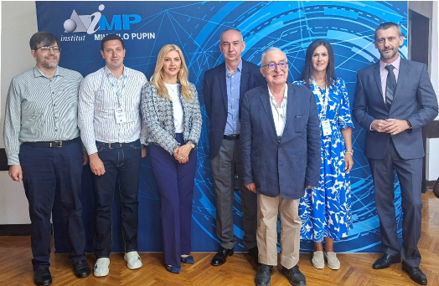
Organizing Committee members and keynote speakers
Overall, the 18th DEMSEE Congress confirmed the importance of DEMSEE as a regional meeting point for power system professionals. The discussions showed that the future of power system operation will depend not only on new technologies, but also on reliable models, high-quality data, validated software tools, strong procedures, regional coordination, and competent engineers.
Also, DEMSEE CONGRESS proves once more its value as an affiliate CIGRE event. Leading cigreans were present. The value of the CIGRE membership was stressed, and among the 70 delegates from five Countries (America and Egypt, Greece, Norway, and Serbia) a large percentage were young engineers.
The main conclusion of the Congress was that electricity markets, system operation, digital transformation, and regional coordination cannot be treated separately. The integration of renewable energy sources, the growing complexity of power flows, the need for resilience, and the increasing role of advanced decision-support tools require continuous cooperation between TSOs, DSOs, RCCs, academia, industry, regulators, and market participants.
DEMSEE 2026 demonstrated that South-Eastern Europe has both strong operational experience and a clear need for further innovation. Through the exchange of practical results, research outcomes, and lessons learned from real system events, the Congress contributed to the broader goal of building more secure, flexible, resilient, and sustainable power systems in the region and beyond.
Suggested content