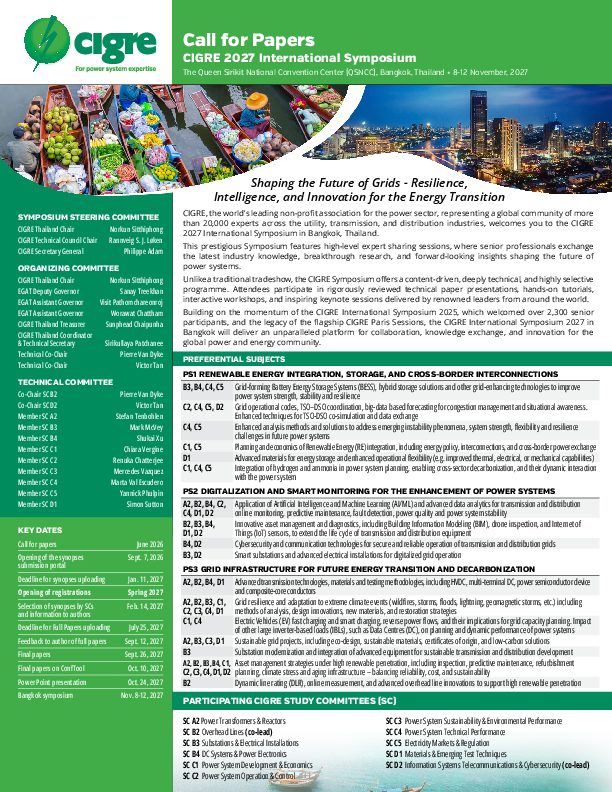
CIGRE International Symposium Bangkok 2027: Call for Papers
Shaping the Future of Grids – Resilience, Intelligence, and Innovation for the Energy Transition

Hosted by CIGRE Thailand
Symposium Theme
CIGRE, the world’s leading non-profit association for the power sector, representing a global community of more than 20,000 experts across the utility, transmission, and distribution industries, welcomes you to the CIGRE 2027 International Symposium in Bangkok, Thailand. This prestigious Symposium features high-level expert sharing sessions, where senior professionals exchange the latest industry knowledge, breakthrough research, and forward-looking insights shaping the future of power systems.
Unlike a traditional tradeshow, the CIGRE Symposium offers a content-driven, deeply technical, and highly selective programme. Attendees participate in rigorously reviewed technical paper presentations, hands-on tutorials, interactive workshops, and inspiring keynote sessions delivered by renowned leaders from around the world.
Building on the momentum of the CIGRE International Symposium 2025, which welcomed over 2,300 senior participants, and the legacy of the flagship CIGRE Paris Sessions, the CIGRE International Symposium 2027 in Bangkok will deliver an unparalleled platform for collaboration, knowledge exchange, and innovation for the global power and energy community.
Preferential Subjects
PS1: renewable energy integration, storage, and cross-border interconnections
- Grid-forming Battery Energy Storage Systems (BESS), hybrid storage solutions and other grid-enhancing technologies to improve power system strength, stability and resilience (B3, B4, C4, C5)
- Grid operational codes, TSO–DSO coordination, big-data based forecasting for congestion management and situational awareness (C2, C4, C5, D2)
- Enhanced techniques for TSO-DSO co-simulation and data exchange Enhanced analysis methods and solutions to address emerging instability phenomena, system strength, flexibility and resilience challenges in future power systems (C4, C5)
- Planning and economics of Renewable Energy (RE) integration, including energy policy, interconnections, and cross-border power exchange (C1, C5)
- Advanced materials for energy storage and enhanced operational flexibility (e.g. improved thermal, electrical, or mechanical capabilities) (D1)
- Integration of hydrogen and ammonia in power system planning, enabling cross-sector decarbonization, and their dynamic interaction with the power system (C1, C4, C5)
PS2: Digitalization and smart monitoring for the enhancement of power systems
- Application of Artificial Intelligence and Machine Learning (AI/ML) and advanced data analytics for transmission and distribution online monitoring, predictive maintenance, fault detection, power quality and power system stability (A2, B2, B4, C2, C4, D1, D2)
- Innovative asset management and diagnostics, including Building Information Modeling (BIM), drone inspection, and Internet of Things (IoT) sensors, to extend the life cycle of transmission and distribution equipment (B2, B3, B4, D1, D2)
- Cybersecurity and communication technologies for secure and reliable operation of transmission and distribution grids (B4, D2)
- Smart substations and advanced electrical installations for digitalized grid operation (B3, D2)
PS3: Grid infrastructure for future energy transition and decarbonization
- Advanced transmission technologies, materials and testing methodologies, including HVDC, multi-terminal DC, power semiconductor device and composite-core conductors (A2, B2, B4, D1)
- Grid resilience and adaptation to extreme climate events (wildfires, storms, floods, lightning, geomagnetic storms, etc.) including methods of analysis, design innovations, new materials, and restoration strategies (A2, B2, B3, C1, C2, C3, C4, D1)
- Electric Vehicles (EV) fast charging and smart charging, reverse power flows, and their implications for grid capacity planning. Impact of other large inverter-based loads (IBLs), such as Data Centres (DC), on planning and dynamic performance of power systems (C1, C4)
- Sustainable grid projects, including eco-design, sustainable materials, certificates of origin, and low-carbon solutions (A2, B3, C3, D1)
- Substation modernization and integration of advanced equipment for sustainable transmission and distribution development (B3)
- Asset management strategies under high renewable penetration, including inspection, predictive maintenance, refurbishment planning, climate stress and aging infrastructure – balancing reliability, cost, and sustainability (A2, B2, B3, B4, C1, C2, C3, C4, D1, D2)
- Dynamic line rating (DLR), online measurement, and advanced overhead line innovations to support high renewable penetration (B2)
Participating Study Committees
The following CIGRE Study Committees will participate in the symposium:
- A2 - Power transformers & reactors
- B2 - Overhead lines (co-lead)
- B3 - Substations and electrical installations
- B4 - DC Systems & Power Electronics
- C1 - Power System Development & Economics
- C2 - Power System Operation & Control
- C3 - Power System Sustainability & Environmental Performance
- C4 - Power System Technical Performance
- C5 - Electricity Markets & Regulation
- D1 - Materials & Emerging Test Techniques
- D2 - Information Systems Telecommunications and Cybersecurity (co-lead)
Download the Call for Papers (September 2026)
Papers publication
Papers will be available to download one month in advance of the symposium for registered participants. One month after the symposium, papers will be available on on eCIGRE free of charge for CIGRE members. The CIGRE Science & Engineering (CSE) journal will publish the best papers selected from the symposium. The Technical Committee of the Symposium will produce a summary report of the symposium for publication in ELECTRA.
Submission of synopses
Participants wishing to present and publish papers should submit synopses by following the instructions on the website, where the synopses and paper templates are also available. All synopses, papers, and presentations must be in English. Please note that at least one author must present the paper at the symposium.
Deadlines
- Opening of the synopses submission portal: 7 September 2026
- Deadline for synopses uploading: 11 January 2027
- Opening of registrations: Spring 2027
- Selection of synopses by SCs and information to authors: 14 February 2027
- Deadline for Full Papers uploading: 25 July 2025
- Feedback to author of full papers: 12 September 2027
- Final papers: 26 September 2027
- Final papers on ConfTool: 10 October 2027
- Power Point presentation: 24 October 2027
- Bangkok symposium: 8-12 November 2027

The full program will be available closer to the symposium on the Symposium website.
Suggested content