From Fragmentation to Coordination: How the Network Code on Demand Response Reshapes Demand-Side Flexibility in Europe
Europe's electricity system is decentralising rapidly. Rising shares of variable renewable generation, the electrification of transport and heating, and the proliferation of distributed energy resources — electric vehicles, heat pumps and behind-the-meter batteries — are turning demand-side flexibility from an optional system-management tool into a structural requirement. Demand response (DR), the intentional adjustment of consumption or distributed generation in response to price signals or system needs, is now widely recognised as a least-cost source of flexibility for both balancing and congestion management.

By Himani Pasricha
Market Policy Specialist; Distribution Markets & System Operation Design, ESB Networks
Introduction
Yet participation conditions remain markedly heterogeneous across Member States. France and Great Britain permit residential aggregation without prior approval from the Balance Responsible Party, while several jurisdictions — Spain among them — still impose restrictions on smaller participants. Germany has substantial industrial DR capacity but uneven aggregation pathways, and several Member States, including Ireland, are at an early stage of framework development [1]. This regulatory fragmentation has constrained cross-border scalability, discouraged investment in aggregation, and limited market-based procurement of flexibility by system operators.
The Network Code on Demand Response (NC DR), drafted jointly by ENTSO-E and the EU DSO Entity [2] pursuant to a Commission mandate and revised by ACER following public consultation, is intended to address this fragmentation. ACER submitted its final recommendation to the European Commission on 7 March 2025 [3]. At the time of writing, formal adoption is pending; the analysis below is therefore based on ACER's recommendation and the accompanying amendments to the existing balancing and system-operation regimes.
Legal basis and regulatory architecture
The NC DR is being developed under Article 59(1)(e) of Regulation (EU) 2019/943, which empowers the Commission to adopt rules implementing the demand-response, aggregation, energy-storage and demand-curtailment provisions of the Electricity Regulation and Directive (EU) 2019/944 [4]. The proposal does not stand alone: ACER has also recommended targeted amendments to the Electricity Balancing Guideline (EBGL) and the System Operation Guideline (SOGL) [5], to ensure coherence between the new framework and the existing balancing and operational regimes.
A defining feature of the architecture is the use of two parallel implementation tracks: national terms and conditions, adopted at Member-State level by national regulatory authorities, and Union-wide methodologies, approved by ACER. The NC DR sets out high-level principles, while the technical specification of rules — covering matters such as service-provider qualification, baseline calculation, and the design of local flexibility products — is delegated to these national and Union-wide instruments. Article 4 requires Member States to establish national rules of procedure for adopting national terms and conditions within twelve months of entry into force [6]. This two-tier model creates room for national specificities, but also introduces a recognised risk that divergent national terms and conditions and uneven adoption timelines could reproduce the very fragmentation the code seeks to remove [7]. To mitigate this, ACER's revised proposal sequences a Union-wide methodology on the simplification and harmonisation of prequalification ahead of the corresponding national terms and conditions.
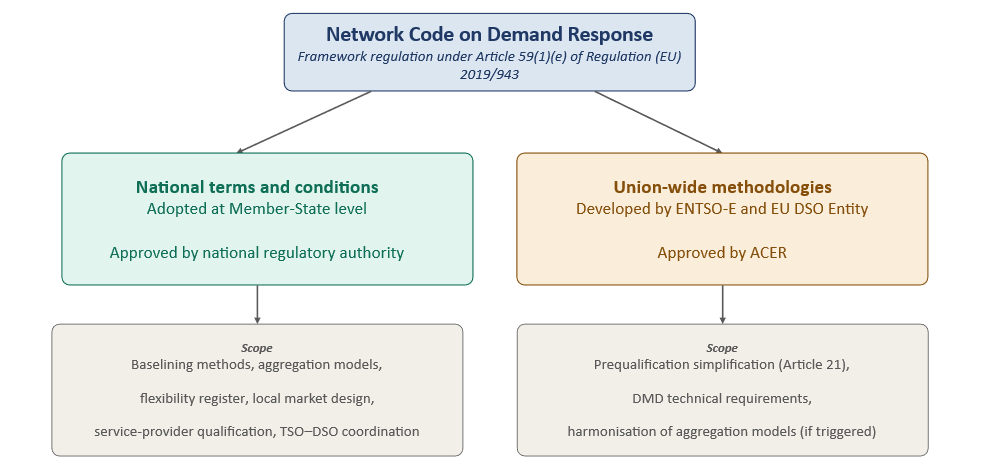
Figure 1 - The two-track regulatory architecture of the NC DR comprises high-level principles in the framework regulation, with technical specifications delegated to national terms and conditions (NRA-approved) and Union-wide methodologies (ACER-approved).
Core regulatory pillars
The substantive provisions of the NC DR fall under four interrelated pillars. Market access: harmonised participation conditions for demand-side resources, including the role of independent aggregators and the calculation of consumption baselines, supported by a European register of baselining methodologies assessed against common criteria of auditability, integrity, accuracy, systemic neutrality and proportionality. Service-provider qualification: simplified prequalification (Articles 16–23) and a Flexibility Information System acting as a common national interface for service providers and controllable units [8]. Procurement of local services: market-based procurement of congestion-management and voltage-control services at distribution level, with limited and justified exceptions. TSO-DSO coordination: structured data exchange and aligned activation of flexibility, intended to prevent counterproductive actions across system boundaries.

Implications for industry actors
For aggregators and flexibility service providers, the NC DR creates a more level playing field across Member States. Harmonised prequalification and standardised access conditions reduce the administrative friction that has historically prevented cross-border scaling, and the framework explicitly enables value stacking — combining revenues from wholesale, balancing, congestion-management and local-flexibility markets. The compatibility of national baselining methodologies with the common criteria will be decisive for portfolio economics.
For DSOs and TSOs, the code formalises a transition from passive network management to active, market-based procurement of flexibility at distribution level. The Dutch GOPACS platform illustrates the volumes already achievable: in two days of operation in November 2024 the platform processed roughly 200 orders and enabled 2 GWh of redispatch [9]. The NC DR aims to provide the regulatory infrastructure for replicating such structures EU-wide. Stronger TSO-DSO coordination — including aligned data exchange and joint activation logic — is presented in the proposal as a precondition rather than an option.
For energy-intensive industrial consumers, the code preserves the voluntary nature of participation and clarifies remuneration principles, while opening clearer pathways to the market. Standardised access rules and improved coordination should allow industries to monetise flexibility with greater predictability, particularly where production schedules and process constraints have so far made participation impractical.
Near-term actions ahead of formal adoption
Although the Commission Regulation has not yet been adopted, ACER has set out twelve no-regret actions that Member States and market participants can implement immediately [10]. These include the deployment of stronger price signals through dynamic and time-of-use tariffs, the simplification of market access for aggregators, the acceleration of smart-meter rollout, the clarification of national DR frameworks, and the early development of flexibility-needs assessments. In parallel, Regulation (EU) 2024/1747 obliges Member States to publish national flexibility-needs assessments and indicative non-fossil flexibility targets [11], providing a concrete planning anchor for the period preceding NC DR enforcement.
Conclusion
The NC DR is best understood not as a distant technical instrument but as a near-term restructuring of the European market for demand-side flexibility. By harmonising market access, qualification, procurement and TSO-DSO coordination across all Member States, it is intended to convert flexibility from a fragmented set of national arrangements into a coherent EU-wide commodity. Its success, however, will depend less on the text of the Regulation than on the quality and consistency of the national terms and conditions and Union-wide methodologies that follow, and on the willingness of Member States to align national implementation. From a DSO perspective, the practical work — designing local flexibility procurement, building the data and IT capabilities behind a Flexibility Information System, and aligning operational processes with TSO counterparts — will need to begin well before the regulation enters into force if implementation is to be credible from day one. For aggregators, system operators and industrial consumers, the period before formal adoption is therefore not a waiting room but a preparation window — one in which positioning, partnerships and capabilities can be built ahead of the rules locking in.
References
- smartEn and LCP Delta, 2024 Market Monitor for Demand-Side Flexibility, February 2025. Available online.
- ENTSO-E and EU DSO Entity, Proposal for a Network Code on Demand Response, submitted to ACER, May 2024. Available online.
- ACER, Recommendation No 01/2025 of 7 March 2025 on the proposal for a network code on demand response. Available online.
- Regulation (EU) 2019/943 of the European Parliament and of the Council of 5 June 2019 on the internal market for electricity (recast), Article 59(1)(e), OJ L 158, 14.6.2019. Available online.
- Commission Regulation (EU) 2017/2195 of 23 November 2017 establishing a guideline on electricity balancing (EBGL); Commission Regulation (EU) 2017/1485 of 2 August 2017 establishing a guideline on electricity transmission system operation (SOGL). Available online.
- Draft Network Code on Demand Response, Article 4 (national rules of procedure for the adoption of national terms and conditions and Union-wide methodologies), v1.0, 5 September 2024. Available online.
- Magnus Energy, NC DR Brief: A Guide to the Proposed EU Network Code on Demand Response, June 2025. Available online.
- Draft Network Code on Demand Response, Articles 16–28 (prequalification and Flexibility Information System), v1.0, 5 September 2024. Available online.
- GOPACS, operational data, November 2024. Available online.
- ACER, Unlocking Flexibility: No-Regret Actions to Remove Barriers to Demand Response, April 2025. Available online.
- Regulation (EU) 2024/1747 amending Regulation (EU) 2019/943, introducing Member-State flexibility-needs assessments under Article 19e. Available online.

Banner & thumbnail credit: inkoly on iStock
Suggested content