Risk and asset health based decision making in existing substations
Satisfactory performance of substation equipment is critical for any utility company. During their service life such assets transition from new to being aged by having one or more developing failure modes, and if left unattended eventually reaching the point of failure. The need is then to have the capability to identify the time frames for these transition stages. The Technical Brochure describes risk based methodologies for all significant asset types. Firstly, they can be used to create asset specific plans for maintenance, refurbishment and asset replacement. Secondly, they can provide resilience information on a functional basis through a network. Each is part of the asset management credo that all assets should have lifetime management plans to meet business objectives.
Members
Convenor (IE)
J. BEDNAŘÍK
Secretary (US)
E. MORALES
A. BABIZKI (DE), ALBERT LIVSHITZ (US), A. GOYVAERTS (BE), D. O'BRIEN (GB), D. GANNON (GB), G. BALZER (DE), J. SMIT (NL), S. KUMAR (IN), T. WEHRSTEDT (DE), T. MCGRAIL (GB), U. KUMAR DAS (IN), V. FERRERAS ALVAREZ (GB)
Corresponding Members
A. WILSON (GB), B. VAN MAANEN (NL), C. BALOYI (ZA), C. BECKETT (AU), C. MCCAHEY (IE), D. KOMLJENOVIC (CA), H. MANNINEN (EE), J. LAULETTA (US), J. PRAZNIK (SI), K. TAKETA (JP), K. TILL (GB), L. MCCARTNEY (IE), L. FIGUEROA (FR), M. KHALIL (PL), R. CSELKÓ (HU), T. JUNG (CA), S. KHUNTIA (NL)
As electrical substations age, asset managers and grid operators face growing challenges in ensuring the reliability, safety, and efficiency of their assets while maintaining financial viability and regulatory compliance. Risk and asset health-based decision-making serves as a cornerstone in optimising maintenance, refurbishment, and replacement strategies, allowing utilities to prioritise interventions based on up to date condition assessments, probabilistic failure predictions, and comprehensive consequence analysis. Moreover, a structured risk and asset health framework supports optimised maintenance strategies, reducing reliance on reactive interventions and enhancing operational efficiency.
Condition-based and predictive maintenance models allow asset managers to extend asset lifecycles, defer capital-intensive replacements, and optimise budget allocation. This proactive strategy also enhances regulatory compliance by ensuring alignment with evolving industry standards such as ISO 55000 for asset management [3], IEC reliability guidelines, and governmental frameworks governing grid operations.
Embracing risk and asset health-based decision-making empowers utilities to manage the complexities of modern power networks while maintaining reliability, safety, and financial sustainability. This methodology not only optimises asset performance but also aligns with broader industry goals of sustainability, regulatory compliance, and long-term grid modernization. By integrating advanced risk quantification techniques, leveraging digitalization, and adhering to regulatory standards, asset managers can enhance their asset management strategies and improve overall grid resilience.
The aim is to describe a process that can be used to classify substation assets in terms of their changing risk level consequent to an in-service failure. The likelihood of failure is expressed as an Asset Health Index (AHI). Both it and a risk index are evolving evaluation changing throughout an asset’s lifetime being part of a life plan for the assets owned.
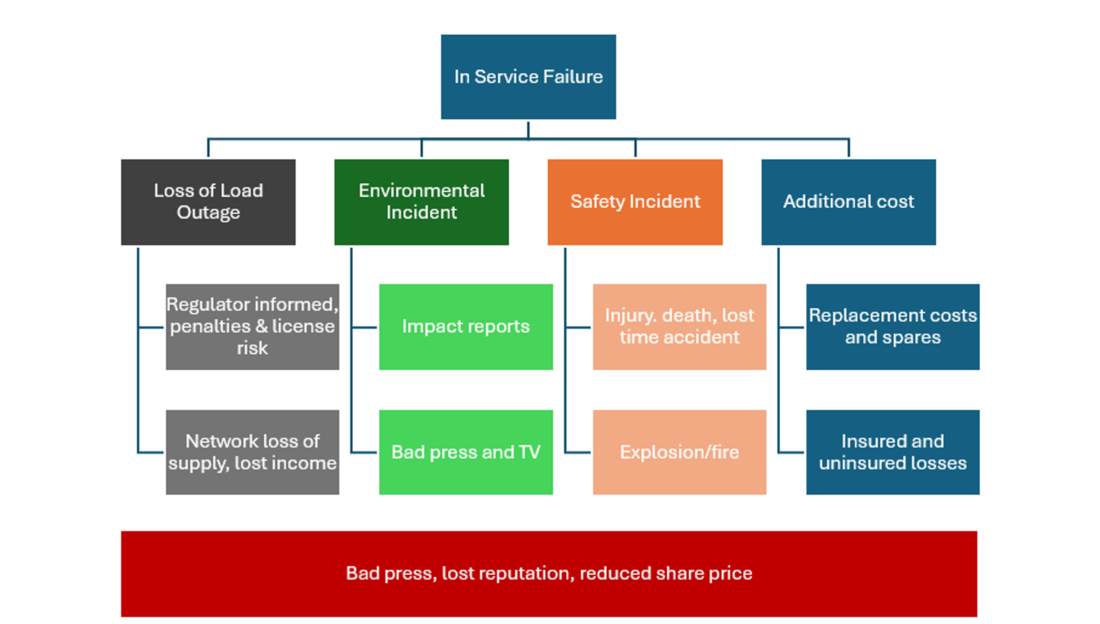
Figure 1 – Failure impact examples
Risk evaluation
One method of this asset management optimisation is called Risk Based Maintenance. With this approach, the likelihood and the consequence of the asset in-service failure is combined into a risk index. The asset maintenance is then prioritised based on those findings. Assets that are in good condition and with a low consequence of failure do not require the same attention as the assets with a critical condition or assets whose failure would have a significant impact.
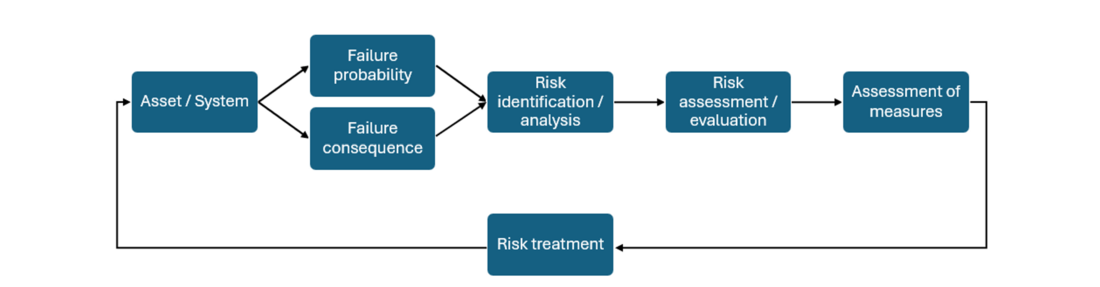
Figure 2 – Workflow of the risk assessment process [2]
TB structure
Chapter 2 of this TB covers the likelihood of failure based on the condition assessment. This chapter builds on the work of B3.48 published as TB 858 “Risk and asset health-based decision making in existing substations” [1].
Chapter 3 discusses methods of assessing the consequence of the failure. It defines the consequence parameters and evaluates the consequences of individual failure modes. From many methods discussed, a recommendation is presented that enables comparison of the consequences between assets and asset types. Monetisation method is provided as meeting this requirement.
ELECTRA, is the digital magazine of CIGRE, you can obtain access as part of a CIGRE membership. Find out more about joining options here.
Other Technical Brochures