Further Investigations on a DC Tracking & Erosion Test
The resistance to tracking and erosion by surface discharges and arcing is an essential property of polymeric insulating materials in high-voltage outdoor application. Existing internationally standardized test methods (IEC 60587, IEC/TR 62039) cover only AC conditions. Various studies have demonstrated higher material degradation and altered ranking under DC stress, highlighting the need for dedicated DC test methods. CIGRE WG D1.72 conducted parameter studies and two international Round Robin Tests based on these studies, but the chosen constant‑voltage DC test methodology still showed high scatter and partially severe erosion of the investigated material formulation. Modified parameters reduced severity but did not improve repeatability or reproducibility. Overall, constant‑voltage DC testing was deemed to be unsuitable. Further investigations suggest that stepwise voltage testing may offer improved repeatability for future standardization.
Members
Convenor (DE)
Jens Lambrecht
Convenor (DE)
Christiane Baer
Secretary (DE)
Stefan Kuehnel
Eric Moal (FR), Derek Oliver (CA), Valeria Blaze (YM) (CA), Takanori Kondou (JP), Bernd Kruska (DE)
Corresponding Members
Konrad Hindelang (DE), Bernd Komanschek (DE), Jens Seifert (DE), Jaka Strumbelj (CH), Joachim Hegge (DE), Fabien Virlogeux (FR), Fabian Lehretz (DE), Behzad Kordi (CA), Stefan Kornhuber (DE), Yasushi Okawa (JP)
Introduction
The tracking and erosion resistance is one of the key properties of polymeric materials for polymeric insulators in high-voltage outdoor application [1]: It was standardised for AC stress decades ago with the inclined plane test (IPT) IEC 60587 [2] (Figure 1). Collecting experiences with DC stress began more than 25 years ago, when DC transmission lines have been equipped with composite insulators. The common result of all performed investigations is such: if identical test parameters for both AC and DC are chosen, the DC stress leads to a more intense tracking and erosion as they can be found at AC. This is especially observed if positive polarity is chosen for testing [3] - [8].
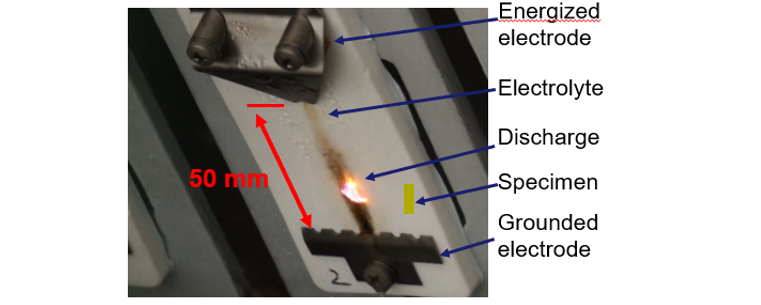
Figure 1 - Test arrangement of the inclined plane test according to IEC 60587
This higher severity results in too harsh testing of investigated materials, their disqualification, but especially in a non-differentiability, which often is in contrast to the service performance of many materials under high voltage DC outdoor conditions. Therefore, various investigations with modifications of test parameters like the reduction of test voltage or the flow rate have been conducted to reduce the test severity and evaluate and differentiate between materials.
First work in CIGRE on DC tracking and erosion under DC stress has been conducted in WG D1.27 and was published in TB 611 [8]. Parameter studies have been conducted to identify main parameters that result in severe erosion and contribute to a big scatter of test results. No conclusion could be found at that time to propose a test method for standardised DC tracking and erosion testing since the requirements on a reproducible and repeatable test method have not been fulfilled (Figure 2). It was recommended instead to continue with corresponding investigations. Due to that, although a few national standards are available nowadays, using the IPT setup [9], [10], no international IEC standard is available yet.
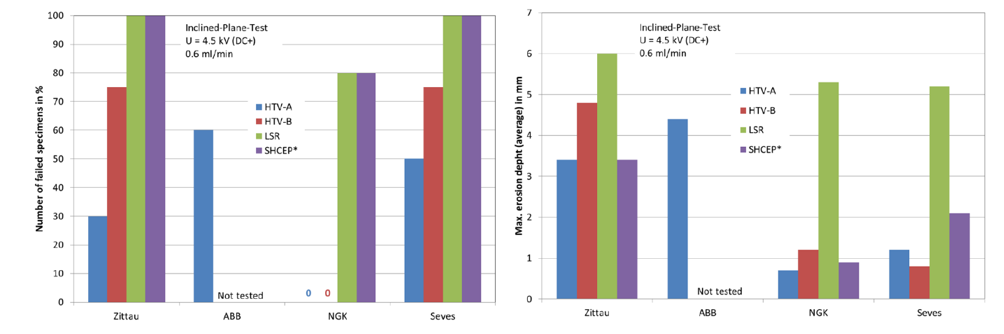
Figure 2 - Number of failed specimens (left) and maximum erosion depth (right) of specimens tested at 4.5 kV DC+ with 0.6 ml/min flow rate
Recent work in CIGRE WG D1.72 has concentrated on basic investigations with the IPT to develop a test method that fulfils requirements for a standardisable test method in IEC with respect to representativeness, repeatability, reproducibility, and cost efficiency.
Scope and Methodology
The starting point for these investigations was taken by considering the basic concept of the IPT method. The general aim of the IPT is an accelerated testing of the tracking and erosion resistance by continuous discharge activity. Under AC, the test parameters voltage, flow rate and series resistor are set as such that continuous discharge activity is achieved. Such parameter studies were missing for DC application so far and were conducted in the CIGRE WG D1.72 at silicone elastomers.
After these investigations, parameters for a DC setup were defined in pre-investigations in such way that continuous discharge activity was achieved, and too severe test conditions were prevented.
In case of severe erosion, the formation of degradation products may influence the test conditions by interrupting continuous discharge activity which are not desirable.
Two round robin tests with constant voltage, one at 4.5 kV DC and another at 3.5 kV DC, both at positive polarity, using one silicone elastomer formulation were conducted at seven test laboratories. The results were evaluated, using statistical analysis methods to prove repeatability and reproducibility.
Description of Technical Brochure
The Technical Brochure is structured into four chapters. Chapter one starts with a scope and objectives of the Cigre WG D1.72 activities.
In chapter two, a review of recent literature is described, including a study on discharge phenomena under DC voltage in simplified model arrangements. The findings can be summarized as such:
The AC inclined-plane test (IPT) was originally designed to classify polymeric insulating materials by applying voltages that ensure continuous scintillation, but transferring this method to DC conditions has led to inconsistent and highly scattered results [4]. Numerous studies and round robin tests showed that constant‑voltage DC IPT does not...
ELECTRA, is the digital magazine of CIGRE, you can obtain access as part of a CIGRE membership. Find out more about joining options here.
Other Technical Brochures