Lifelong Supervision and Management of Substations by Use of Sensors, Mobile Devices, Information and Communication Technologies
This study by CIGRE Joint Working Group B3.D2.62 surveys the options for Life-long Supervision and Management (LLSM) of substations, focusing on the use of sensors, mobile devices, and information and communication technologies (ICT).
The Technical Brochure (TB) examines the impact and opportunities these technologies offer for continuous life-long condition monitoring, data management, predictive maintenance, risk assessment and asset management in substations.
It outlines operational challenges faced by utilities, reviews applicable technologies, and provides practical recommendations. Case studies from around the world illustrate how LLSM can enhance reliability, safety, and cost efficiency. By using advanced analytics, digital twins, and standardized data architectures, utilities can move from reactive to proactive asset management and achieve real-time awareness of substation status.
The findings highlight the importance of integrating new sensor and data technologies with engineering and materials expertise to enable future full LLSM adoption and informed decision-making. The paper concludes that emerging trends in sensors, microelectronics, and advanced data technologies will continue to impact and shape the substations of the future.
Members
Convenor & Secretary (DE)
Nicolaie Fantana
Section Leaders
Eric Frenette (CA), Nicolas Rossi (FR), Liang Yun (CN), Jianguo Wei (CN), Krzysztof Lowczowski (PL)
Miha Becan (SL), Gautam Talagery (US), Ethan Koch (US), Geqi Li (CN), Tommie Linquist (SE), Paul Myrda (US), Sami Maki (FI), Tony McGrail (UK), Besteiro Pacin (ES), Jianbin Fan (CN), Hao Hu (CN), Gabriel Lopes (DE), Nobuko Otaka (JP), Johan Smit (NL), Andreas Kurz (DE), Alan Soares (BR), Niels De Winter (NL), Hanno Stagge (DE), Julien Mathey (FR), Akinori Sugawara (JP), Yuki Yatabe (JP)
Motivation
Electrical substations are essential nodes in modern power systems, serving as the link between power generation, transmission, and distribution. They operate under demanding conditions, often for decades, and their reliable performance is critical to the stability of the grid. Recent technological advances, particularly in sensors, mobile devices, ICT, and the broader trend towards digitization are transforming both the construction and maintenance of substations, as well as the way assets are managed throughout their life.
Sensors embedded in equipment or deployed in the field enable continuous monitoring of electrical, mechanical, and environmental parameters. Mobile devices facilitate efficient data collection, remote access to asset information, and augmented reality-based maintenance support. ICT solutions provide the backbone for integrating these capabilities into comprehensive asset management platforms. Digitization enables the development of digital twins and the application of advanced analytics, which in turn support predictive and prescriptive maintenance strategies.
These advancements also introduce challenges. Substation assets have lifespans measured in decades, and the technologies used for monitoring and management must remain operational, interoperable, and maintainable over these extended periods. Managing the evolution of hardware, software, and data standards while ensuring cybersecurity and cost efficiency is a complex task. This requires a strategic, long-term approach to technology adoption and integration, which is the core focus of the Technical Brochure.
The Technical Brochure (TB) developed by CIGRE Joint Working Group B3.D2.62 addresses the practical and strategic aspects of implementing LLSM in substations. Its goals are to:
- Assess the operational monitoring needs of substations with diverse equipment age profiles and configurations.
- Identify and review technologies such as sensors, communication systems, mobile tools, IoT devices, etc., that can enhance substation supervision, monitoring and diagnostics.
- Review lifetime data management, from acquisition to analysis and applications, with focus on substation management and decision support.
- Present case studies that demonstrate the value of LLSM in improving reliability, reducing costs, and extending asset life.
- Offer conclusions and recommendations for utilities to plan and implement LLSM solutions effectively.
By bringing together global expertise, the TB aims to guide utilities through the complexities of modernizing substation supervision while ensuring alignment with evolving technical standards and operational realities.
Structure of the Technical Brochure
The TB is structured into four main areas, each addressing a distinct aspect of LLSM:
- Lifelong supervision and management of substations – status, needs, challenges – Analysis of the current landscape and identified operational challenges.
- Substation technologies and applications status, needs, trends, with emphasis on substation supervision and management over decades – Review of current sensor, communication and existing or emerging technical solutions.
- Data management, analysis, and processing – for lifelong substation supervision and management – collecting and handling and processing large volumes of lifetime data.
- Applications for substations – example cases – Real-world implementations demonstrating the use of sensor, communication, IOT and data processing benefits.
The appendices provide extensive survey data on status, installations, technologies used, plans for future and a listing of needs for substation lifelong supervision and management.
Lifelong supervision and management of substations – status, needs, challenges
This section establishes the context for LLSM by examining the global diversity of substation assets. It highlights the disparities in age, design, and monitoring capability between transmission and distribution levels. World-wide surveys conducted by the working group revealed that while substations at the higher voltage levels most often benefit from permanent monitoring systems, sensor and digitalization, medium to low-voltage substations frequently operate with no or minimal digital oversight. Figure 1 and Figure 2 present the installed equipment and predominant supervision systems or practices for HV-MV and MV-LV substations.
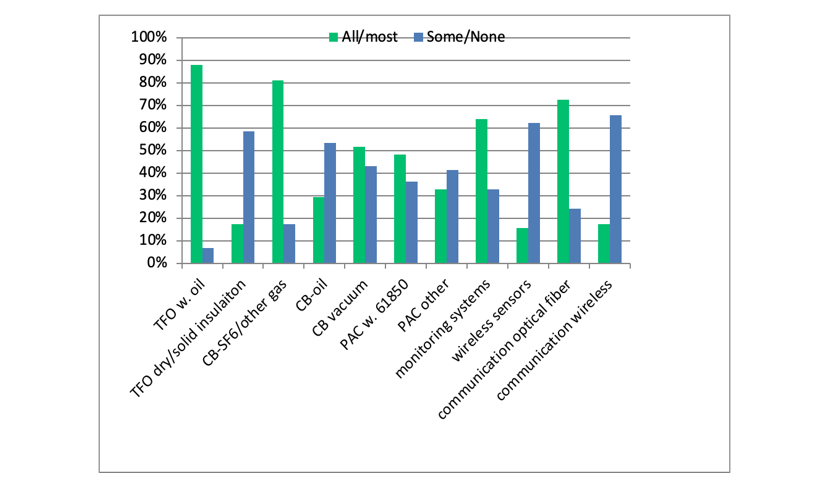
Figure 1 - Typical installed equipment in HV-MV substations – survey
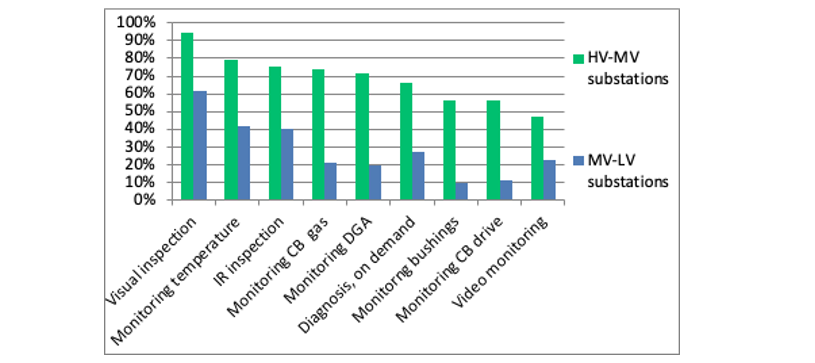
Figure 2 - Typical/predominant supervision practices used in your utility / your geographical area for HV-MV and MV-LV substation equipment – survey
Key challenges include:
- Increase real-time visibility of status and condition of substation assets effectively, even if distributed over large areas
- Collection and integration of data from multiple activities, sensors and systems.
- Difficulty justifying investment in advanced monitoring, sensors and communication for smaller substations.
- Getting timely and useful decisions based on collected data considering installed equipment design, operation, material and longtime degradation knowledge.
The section underscores the need for scalable, cost-effective solutions that can be tailored to the specific risk profiles and operational requirements of different substation types.
Technologies and applications status, trends
The TB surveys the wide array of sensing, monitoring, and automation technologies applicable to LLSM. Sensor categories include thermal imaging, acoustic and ultrasonic monitoring, vibration sensors, partial discharge detectors, and environmental condition sensors. Mobile devices such as rugged tablets, smartphones, and wearable devices are reviewed for their role in field data acquisition and augmented reality-assisted maintenance.
The section also examines communication infrastructure, from wired Ethernet and optical links to wireless mesh networks and cellular IoT solutions. Integration of autonomous or guided robotic devices such as inspection drones and mobile robots, is adding further capability for safe and efficient inspection of difficult-to-reach assets. Trends point towards increasing adoption of edge computing for real-time data processing, the use of standardized communication protocols to ensure interoperability and virtualization. Figure 3 shows the survey results for sensor types used or planned to be used in substations and Figure 4 sensor examples.
ELECTRA, is the digital magazine of CIGRE, you can obtain access as part of a CIGRE membership. Find out more about joining options here.
Other Technical Brochures