Neutral Earthing Method Selection and Earth Fault Handling for Substations in the Distribution Networks
The method of neutral earthing selected for a galvanic separated network is decisive for the supply reliability and safety of operation. It has a large impact on details in substation design. The report gives classification of methods and required equipment for fault protection, localisation as well as detailed equipment design and selection. Furthermore, the worldwide practise is reflected in the results of a worldwide survey.
Members
Convenor (DE)
Theodor CONNOR
Secretary (UK)
Tony YIP
Hugh BORLAND (IE), Gert MADONSELA (ZA), Bill CARMAN (AU), Espen MASVIK (NO), Bruno CERESOLI (IT), Fazel MOHAMMADI (CA), Gernot DRUML (AT), Mark OSBORNE (UK), Christian EHLERT (DE), Bingyin XU (CN), Lothar FICKERT (AT), Kristine VALENTINSEN (NO)
Introduction
There is a large variety of methods for neutral earthing in distribution grids applied all over the world. These methods will be decisive for substations as they will influence the level of line to earth fault current and the line to earth voltages. Furthermore, the methods differ in fault duration, customer supply quality, operational efforts, fault localisation and costs.
As networks nowadays are under permanent development e.g. aging equipment, integration of renewables, conversion of overhead lines to cables, increase of supply reliability, automation etc., it is necessary to summarise the experience gained in different countries and network configurations.
This was the background for CIGRE to trigger a working group to analyse the practice in different countries, to highlight the physical background and interdependencies. The result could be taken as a basis for guidelines to install adequate earthing systems in substations with respect to safety and costs as well as enhancing fault detection and localization. Furthermore, the required equipment for protection and neutral point treatment can be specified and operational guidelines developed.
It is essential to note that the method of neutral earthing is a parameter which is relevant for an entire, galvanically interconnected network. Under this umbrella, each substation in the network has to be designed in a way to withstand the fault current level, the transient and power frequency voltages, provide safe working conditions in case of a line to earth fault as well as frequency of events, fault duration and possibility of cascading events.
Scope / Methodology
In order to gather the practical experience in a larger number of countries the Working Group decided at the very beginning to start a questionnaire. For this purpose, it was essential to start with definitions to be the basis for comparable feedback.
The questionnaire had 24 Questions related to understand the configuration of the distribution network and the applied method of neutral earthing. Furthermore, the method of earth fault identification and localisation, the frequency of events and cause of earth fault. Finally, the question was put if there are future chances intended.
The Working Group was happy to receive 56 answers from 19 countries.
In parallel to the questionnaire the Working Group started in smaller subgroups to draft chapters on the definition of methods, physical behaviour of voltages and currents under fault condition, principles to detect fault condition and enable fault localization, review operational practices, summarize the typical equipment needed for neutral treatment, describe the requirements for design of adequate earthing systems and analysing staged fault tests.
Description of the Technical Brochure
Definitions
At the start of the project, it was realised that a common wording for equipment and operational procedures is essential. Therefore, the Working Group started with a block of definitions.
In addition to four fundamental neutral earthing methods, there are several augmented methods defined which are technically analysed and explained in detail in chapter 4.
An important area of definitions are the operational priorities and the voltages.
A table was developed to visualise the interdependencies between neutral earthing method and operational target.
Reasons for neutral treatment
In normal operation the neutral treatment has no impact on the supply of customers. But in case of a phase to earth fault the behaviour with respect to fault current magnitude, voltage rise of fault free phases, fault duration, customer supply interruption, operational stresses, etc. depends on the applied method of neutral earthing, the equipment installed, the experience of the staff.
The chapter gives an overview of the relevant parameters to be observed.
Fundamentals of neutral treatment methods
For the four fundamental methods the physical behaviour of the system under earth fault condition is described giving typical parameters for currents, voltages, duration and operational challenges.
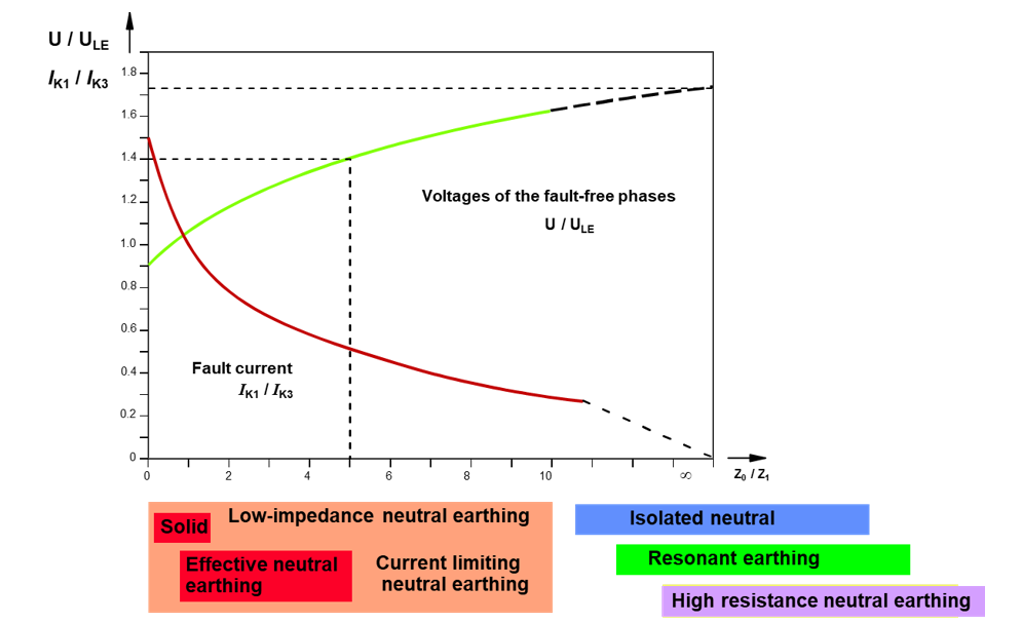
Augmented neutral treatment methods
In addition to the four fundamental neutral treatment methods this chapter outlines various augmentations and switching techniques to improve the performance and to level deficiencies.
Protection
This chapter gives an introduction into the physical parameters available to detect earth fault conditions and the adequate technical solution applied in products.
In addition to earth fault detection special considerations are given for earth fault localization which of course is more a network related topic.
Finally, system wide protection is listed where the substation installation acts as a backup for the network.
Equipment details
In this chapter the general neutral point access is highlighted.
Special considerations are given for the selection and design of arc suppression coils and their tuning.
A further topic are the surge arrestors which have to withstand different specific stresses resulting from the neutral treatment method applied.
Safety aspects
In this chapter the earthing system of a substation is the focus.
There are rules for conductor sizing and principles to manage the potential rise under fault conditions.
For safety reasons the impact of interference with metallic structures resulting from different physical coupling effects needs to be considered.
Measuring equipment
The are special requirements for measuring schemes for protection functions for different neutral earthing methods. In addition to the different schemes there are also requirements for measurement accuracy.
ELECTRA, is the digital magazine of CIGRE, you can obtain access as part of a CIGRE membership. Find out more about joining options here.
Other Technical Brochures