Traceable Measurement Techniques for Very Fast Transients
The Technical Brochure of WG D1.60 deals with traceable measurements of very fast voltage transients which occur in electric power networks as well as those used for testing high-voltage equipment. The technical brochure focuses on techniques for establishing measurement traceability that underpins the validity and credibility of the measurement. The technical brochure shows that traceable calibrations of the measurement systems can be performed now with adequate measurement uncertainties. The findings and conclusions of this technical brochure may help engineers in finding solutions for their specific fast transient measurement challenges. It is also hoped that the technical brochure may provide technical basis for formulating requirements for measurement of fast transients, including measurement uncertainties, in relevant IEC standards.
Members
Convenor (AU)
Yi Li
Secretary (FI)
Jari Hällström
Anders Bergman (SE), Alf-Peter Elg (SE), Ricardo Diaz (AR), Orsino Borges Filho (BR), Fernando Garnacho (ES), Joni Kluss (SE), Willian Larzelere (US), Guoming Ma (CN), Johann Meisner (DE), Johannes Rickmann (DE), Shigemitsu Okabe (JP), Haiming Shao (CN), Takayuki Wakimoto (JP), Wei Yan (AU)
Introduction
Measurement of fast voltage transients is necessary in many fields of electrical engineering and the voltage transients come with many different types of waveforms and voltage amplitudes. A common characteristic of the fast voltage transients is that they all share similar steepness of voltage rise, with the steepest in the range of 2.5 kV/ns, despite of their differences in their peak voltage levels and rise times. Measurement of these transients with proven measurement traceability is a topic that hasn’t been widely understood and standardised. The so-called measurement traceability is the critical property of measurement that the measured result can be related to an international or national reference (international or national) through a documented unbroken chain of calibrations, each with stated measurement uncertainties. This technical brochure describes traceable calibrations of the measurement systems that can be performed with measurement uncertainties that fit for the purposes of the measurements and/or tests.
Measurement of fast voltage transients is required in a number of high-volage tests in accordance with IEC standards. These tests involve voltage impulses of different voltage levels and steepness of the voltage transients, typically up to 2.5 kV/ns. These include
- the steep-front impulse for testing polymer insulator (IEC 62217) with peak voltages up to 1000 kV and rise times around 500 ns,
- the short front impulse (IEC 61211) for puncture tests of glass/ceramic insulators with the peak voltage in the range of 250 kV to 350 kV and the rise time down to 100 ns,
- the fast impulse (IEC 60034-15) for testing inter-tun insulation of stator windings with the peak voltage in the range of 35 kV to 85 kV and rise time around 200 ns,
- electrical fast transient (burst) for immunity testing of low-voltage equipment with the peak voltage up to 4 kV and the rise time 5 ns,
- the transmitted over voltage test on air insulated instrument transformers (IEC 61869-1), with voltage levels up to a few kilovolts and rise time down to nanoseconds at the secondary winding under test.
Apart from the above fast voltage transients, another much faster voltage transient is the very-fast-transient-overvoltage (VFTO, IEC 60071-1) encountered in high-voltage GIS systems, with a steepness value in the range of 10 – 20 kV/ns and the peak voltage often in the megavolt range. An example of VFTO waveforms measured with sensors in GIS is shown in Figure 1.
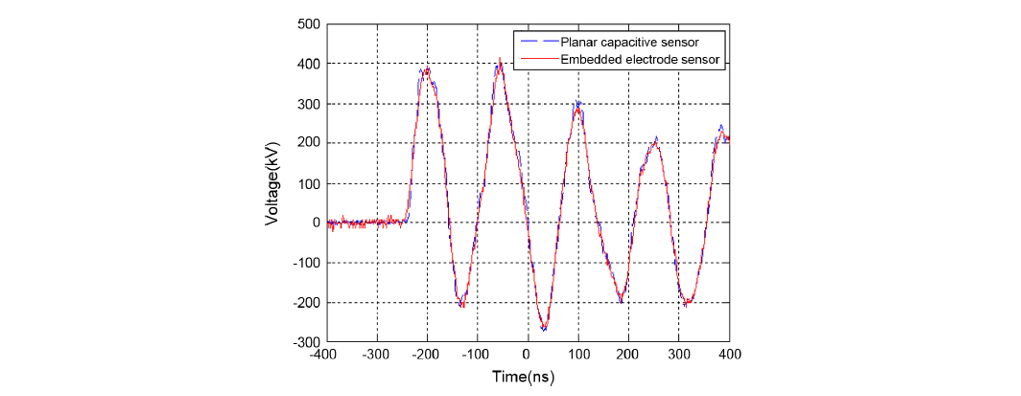
Figure 1 - Transient waveforms measured by sensors embedded in UHV GIS
This Technical Brochure deals with these specific transient measurements in separate chapters, with an Appendix dedicated to the topic of the deconvolution technique and its application to fast transient measurements. This article does not cover all of the specific measurements in the technical brochure. Only some chapters are summarised here to give readers an introduction to the measurement techniques involved.
Measurement of Very Fast Transient Over-Voltage (VFTO)
The very fast transient over-voltages (VFTO) are fast high-voltage pulses produced in gas-insulated substations (GIS). The amplitudes of the pulses may reach up to approximately 3 p.u. of the circuit breaker operating voltages, which often equates over 1 MV. VFTO pulses can be measured by capacitive sensors of various designs and measurement results are often compared with results of calculations based on circuit models (Figure 2)
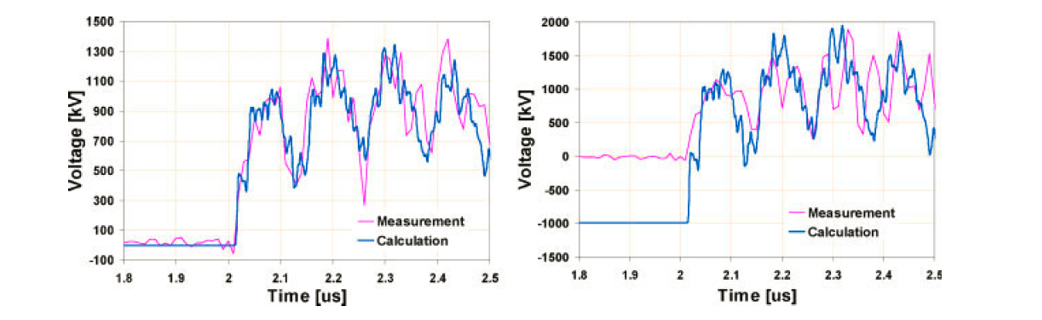
Figure 2 - Calculated and measured VFTO waveforms when switching a GIS disconnector, without pre-charging (left) and with pre-charging (right)
Traceable calibrations of VFTO sensors can now be performed in laboratories using a physical model that replicate the structure of the GIS chamber to house the sensors under calibration. The sensors under calibration are installed in the service locations in the replicated GIS model chamber (Figure 3). Results of a comparison measurement of the sensors are shown in Figure 4.
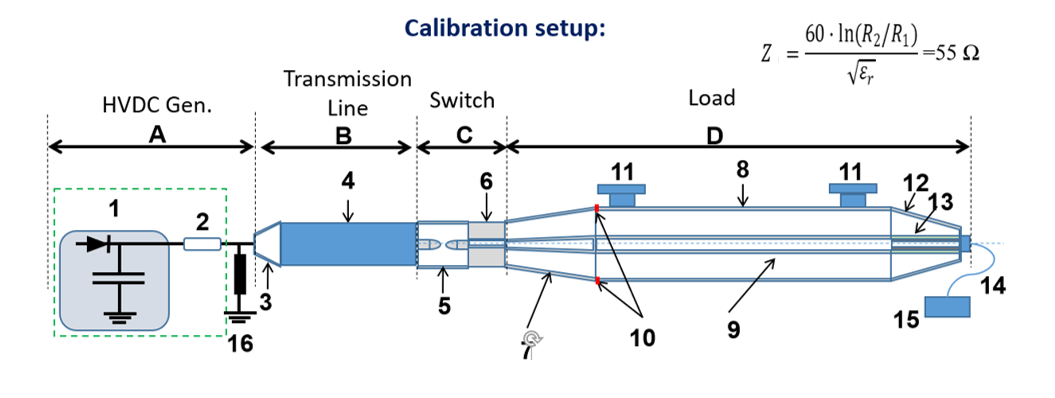
Figure 3 - Schematics of the capacitive sensor mounted in a GIS flange for calibration of the sensor
1) HVDC generator, 2) Resistor, 3) Bushing, 4) Transmission line, 5) Spark-gap, 6) Cylindrical matching, 7) Conical matching, 8) Main Duct, 9) Conductor, 10) Control Dot probes, 11) Window for the sensor to be calibrated, 12) Matching resistor compartment, 13) Reference HV divider, 14) Measuring cable, 15) Digitizer, 16) HVDC Measuring System
ELECTRA, is the digital magazine of CIGRE, you can obtain access as part of a CIGRE membership. Find out more about joining options here.
Other Technical Brochures