Restoration of cyclone damage in rural Western Australia through long-term off-grid supply
This paper is about an extremely rare cyclone that impacted a rural portion of Western Australia’s (WA) unique South West Interconnected System (the SWIS) and the work required to recover it.

Manager, National Wholesale Regulation for Alinta Energy in Western Australia
In early 2021, cyclone Seroja made landfall in WA, striking Kalbarri, a small town on the northern tip of the SWIS with gusts of almost 200km/hr.
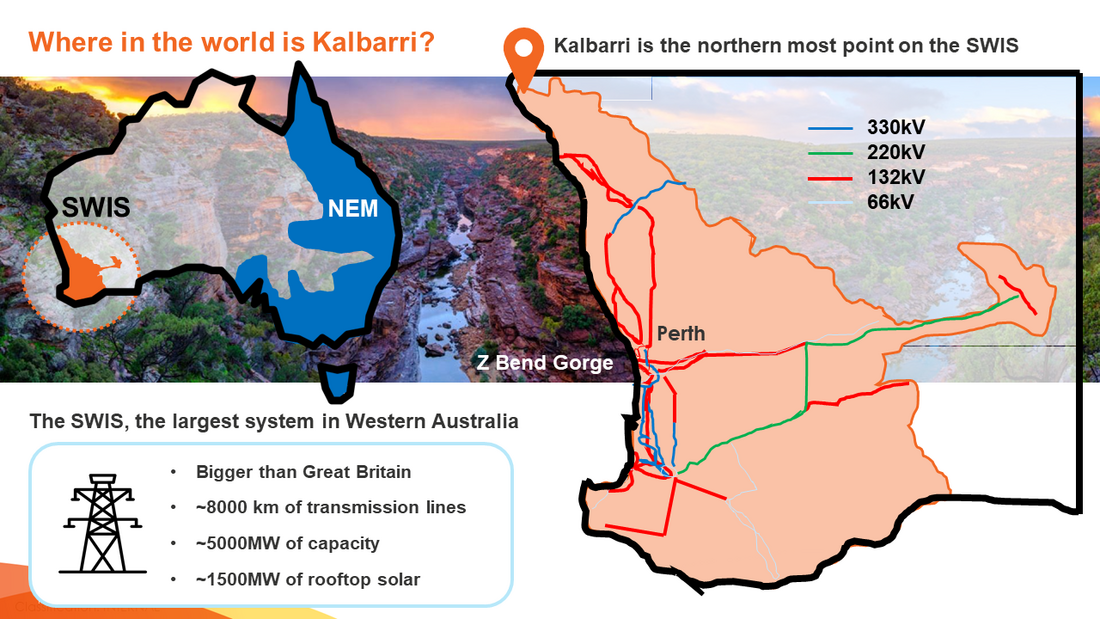
Kalbarri is ~600km north of Perth, Western Australia’s capital or ~6 hour’s drive from the state’s population centre, Perth.
Is it is the northern most point of Western Australia’s electricity system called the ‘South West Interconnected System’, or the ‘SWIS’ shown in orange.
Kalbarri is emblematic of the SWIS, in that it is a town connected by a long stringy line. The SWIS is characterised by its sprawl. 8000km of transmission lines service an area bigger than great Britain with less than 5% of the population.
Kalbarri is a holiday town of ~1500 people, the picture in the background is one of it’s attractions, the Z bend gorge.
While cyclones are fairly common in the tropical North of Western Australia, it’s extremely rare for a cyclone of such force to reach so far South, and the infrastructure is not equipped to withstand them. It’s been 50 years since a cyclone came close, and scientists estimate they may be as rare as 1 in every ~190 years.
The immediate impacts I am going to talk about today are specific to Western Australia’s geography and system. However, the recovery, and the work to prepare for similar events in the future raises issues that are relevant for systems elsewhere in the world as we all transition to decarbonised systems and try to improve resilience in the face of climate change.
Cyclone Seroja
Cyclone Seroja originated near Indonesia where it caused deadly and devastating flooding and landslides. The impact on Australia was significantly less but such a severe cyclone had not reached this far south in 50 years. Scientists have since analysed inland ridges of seashells and sand deposited by historical storms to estimate that similar storms have only occurred on average only 1 in every ~200 years over the past 5000 years.
Cyclone Seroja, reached Kalbarri on Sunday 11 April 2021.
Its unusual path, see Figure 1, and intensity were a result of the ‘Fujiwara effect’ which is rare in the region and occurs when two cyclones collide, in this case cyclone, ‘Odette’, circled around to the north and then the east of Seroja.
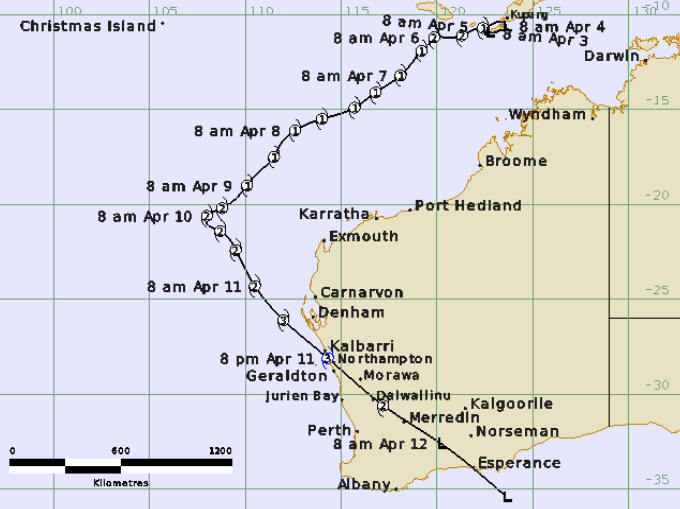
Figure 1 - Track of TC Seroja (Bureau of Meteorology)
This effect strengthened Seroja, by replacing the dry air that had been limiting Seroja's intensity with moist air that could fuel its intensification. The increased moisture combined with lower vertical wind shear resulted in Seroja re-intensifying into a category 2 cyclone while Odette weakened and eventually dissipated.
This also likely redirected Seroja’s path. As you can see from Figure 1, during 10 April, Seroja took a sharp turn towards the southeast and began to accelerate towards the Western Australian coast.
The system further intensified into a severe (category 3) tropical cyclone on 11 April and maintained this intensity through to its coastal crossing just south of Kalbarri around 8pm local time where winds were up to 185km/hr and significantly damaged 70% of buildings.
TC Seroja weakened as it moved further inland tracing a 700km path of destruction south east before it eventually weakened below tropical cyclone intensity early in the morning of 12 April near the town of Merredin. Due to its rapid motion, however, its destructive winds extended a long way inland.
Impact
The impacts of the cyclone are covered here in two parts: to the town and region, and then in terms of the power system.
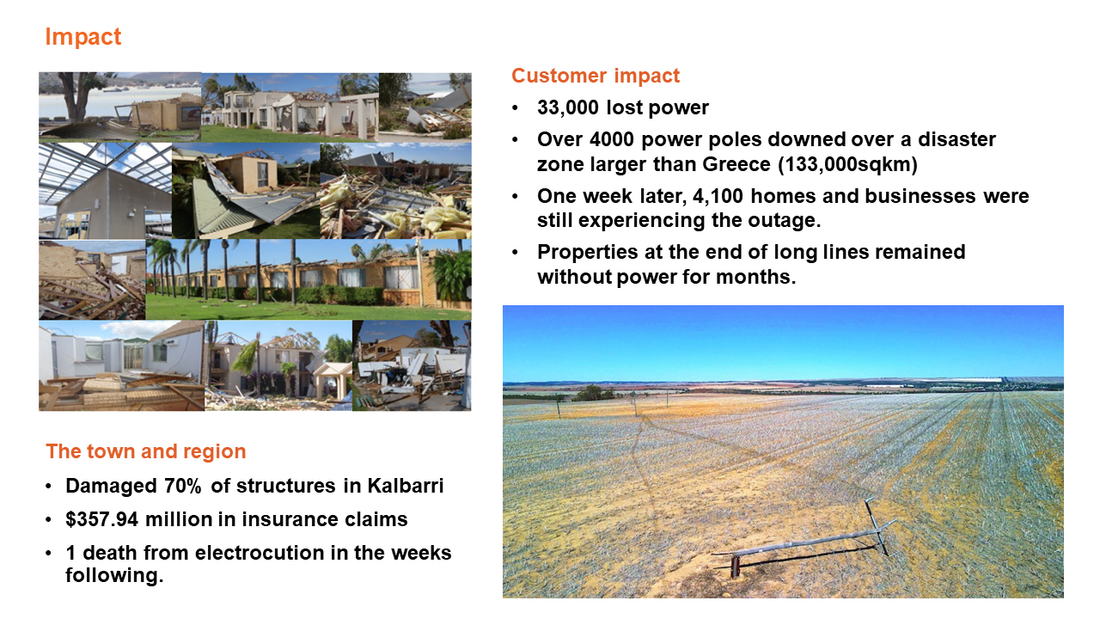
Impact on the town
In the region, the cyclone significantly damaged 70% of structures in Kalbarri, with buildings typically losing rooves, but many destroyed. While devastating for many residents in Kalbarri, it is worth restating they were spared the cascading disasters experienced in East Timor and Indonesia.
The damage bill was between $350 to $400 million, as indicated by the insurance claims.
There was 1 death from electrocution in the weeks following, when a business operator tried to secure a fallen power pole.
Impact on the power system
Over 33,000 customers lost power, with over 4000 still experiencing outages over a week later.
Power lines were downed over an area larger than Greece, a testament to the sprawl of Western Australia’s electricity system, and the length of TC Seroja’s path across the State.
Properties at the end of long lines that had been felled, like farms, were without power for months. This photo gives a sense of the system’s vulnerability to the cyclone, and the damage to such rural lines.
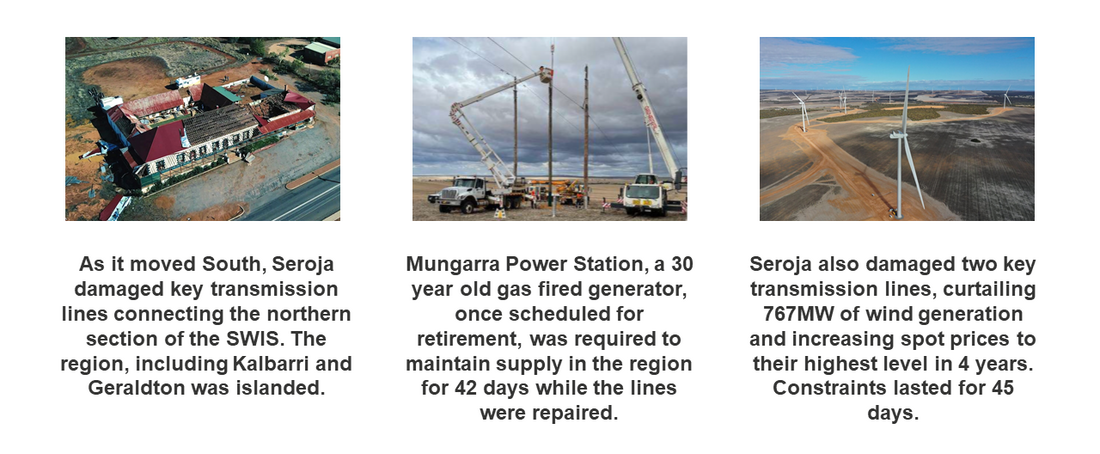
Figure 2 - Damage to the power system
The impacts to the power system went beyond Kalbarri and disrupted the broader electricity system and market:
- Seroja crossed key transmissions lines connecting the northern region and a hub of wind farms to the load centre to the South in Perth.
- The towns to the North, which include the much larger port city of Geraldton were completely islanded and had to rely on a mothballed, aging gas fired facility, that had been scheduled for retirement, to retain power supply for over a month while the lines were repaired.
- Loss of the transmission from Western Australia’s hub of wind farms wreaked the biggest impact to the broader market.
- The region between Perth and Kalbarri where the transmission lines were damaged hosts a world leading wind resource with some more modern wind farms having a long-term capacity factor of ~50%. For this reason, it is home to most of Western Australia’s wind farms and includes plans for many more as the system transitions.
- The damage abruptly disconnected almost 800MW of wind generation and peaked wholesale market spot prices to their highest levels for 4 years over a sustained period.
Recovery
With the damaged area being larger than Greece, the network operator had a huge amount of ground to cover in identifying and repairing the damage to the system.
Laser beams fixed to aircraft helped in this respect. The aircraft allowed engineers to travel quickly, using the laser beams to map damage to the infrastructure.
The effort saw power restored to 85% of the 33,000 affected customers, with 140 transmission poles replaced within a week. To the network operator’s credit, the mobilisation was broad and rapid, with the work completed in this first week equivalent to the work planned for over a quarter of a year.
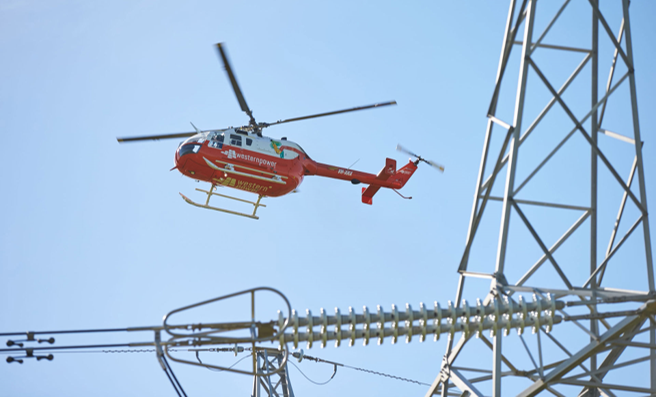
Figure 3 - Assessing tower damage
Standalone power systems (SPS)
The aftermath has accelerated the redesign of Western Australia’s electricity system by highlighting the need for, and benefits of, a more modular structure.
The 6 customers in the region who had previously been equipped with standalone solar power systems by the network operator did not experience any outages during the cyclone.
These standalone power systems (SPS), see Figure 4, comprise solar panels, lithium batteries and a diesel generator, sized to a customer’s load. Power from the solar and batteries are designed to provide ~90% of the customer’s supply.
SPS were then fast tracked for another 35 customers who remained without power months after the cyclone.
Western Power plans to roll out 4000 SPS over the next 10 years, removing the need for 50,000 power poles and 23,000 kilometres of conductor, saving asset replacement costs.
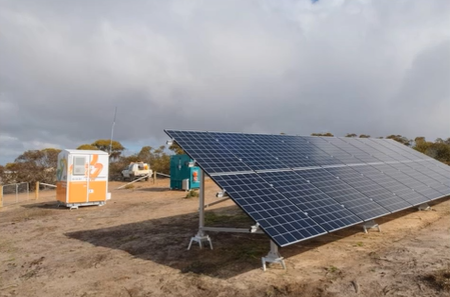
Figure 4 - Stand-alone power systems
Microgrid
Kalbarri has since been converted to a microgrid, Figure 5, potentially improving its resilience to extreme weather.
The microgrid uses 5MW local wind and rooftop solar generation and energy storage to provide a supply to the town when the network connection is interrupted.
First conceived in 2016, the objective was to eliminate 80 percent of outages experienced by the town which occur due to interferences with the 140km feeder line from Geraldton.
Seroja demonstrates the vulnerability of long transmission lines and large contingencies, at a pivotal time in Western Australia’s energy transition.
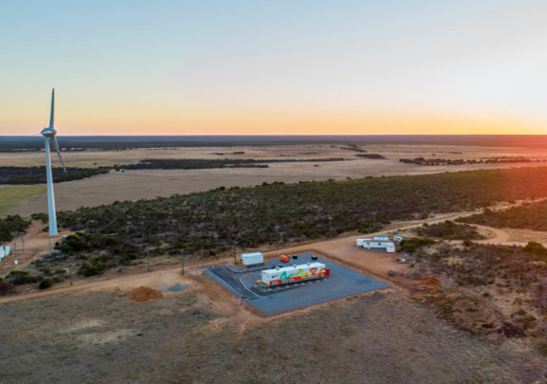
Figure 5 - Kalbarri Microgrid
Power system transition
The WA Govt has recently announced that it will retire its 1200MW coal portfolio by 2030 and not build any more thermal capacity.
Instead, $3.8bn will be invested over 10 years in replacement capacity that will feature about 800MW of new wind and 2000MWh of storage.
Finally, The BoM forecasts more intense cyclones further South due to global warming, and researchers now consider the mid-west region which hosts most of WA’s wind as cyclonic.
These converging factors, coupled with increasing demand for renewable energy, EVs and green hydrogen, will require transformational changes in our system and planning.
Making this transformation possible and achieving least cost will require:
- Significant investment in transmission capacity. We’ll need to build the network to locations that support the wave of renewable generation required.
- Careful consideration of EV charging infrastructure. We need to build chargers where the people leave their cars during the middle of the day. Having the huge load expected from EVs charge during peak times, would fail to utilise our abundance of renewable generation and undermine the purpose of electrification, causing increased costs.
- Climate policy to be integrated with the market so that we can send investment signals that values both renewable energy, and the new and existing dispatchable capacity and services required to support it. Otherwise, we won’t achieve an orderly transition.
- Finally, a level playing field is required to secure private sector investment. Given the huge level of investment required, the government can’t rely on taxpayers to provide subsidies and take on all the risk. To attract private sector investment, we need remove the current level of subsidies. Besides presenting barriers to entry, these subsidies also risk keeping carbon intensive capacity past its efficient closure date.
About Jacinda Papps
This paper is based on a presentation to the Large Disturbance Workshop in 2022 by Jacinda Papps, Manager, National Wholesale Regulation for Alinta Energy in Western Australia. Jacinda manages Alinta’s national wholesale policy and regulatory response to assist with the energy transition. She is also a member of AP C5, the Australian mirror panel of SC C5 Electricity Markets and Regulation.
She is heavily involved in the policy, system planning and market design decisions being made to transition Australia’s electricity systems and deal with the multifaceted challenges posed by government responses to climate change.
Alinta Energy is an electricity generator and energy retailer operating with over 3000MW of owned and contracted electricity generation capacity across Australia and New Zealand and servicing over 1.1 mill electricity and gas customers.
Thumbnail credit: Image generated by IA
Suggested content