Value and Learning: Closing the Loop in Workflow

This is Article 5 in a five-part series that explores the application of Effective Workflow practices. Explore the other articles:
► 1- Understanding workflow: A new paradigm for effective collaboration
► 2- Preparation and Listening: The Foundation of Effective Workflow
► 3- Assessments and Negotiation: Crafting Mutual Commitments in Workflow
► 4- Execution and Performance: Delivering on Promises in Workflow
by Stewart Ramsay and Peter Claghorn, Vanry Associates
In the hustle of daily work, it’s easy to see tasks as isolated items on a to-do list, checked off one by one. Yet, work is rarely a solo endeavor. It’s a dynamic conversation between people striving to create a shared future, driven by what matters most to them. The workflow model, a universal framework for coordinating action, captures this reality by breaking work into four interconnected quadrants.
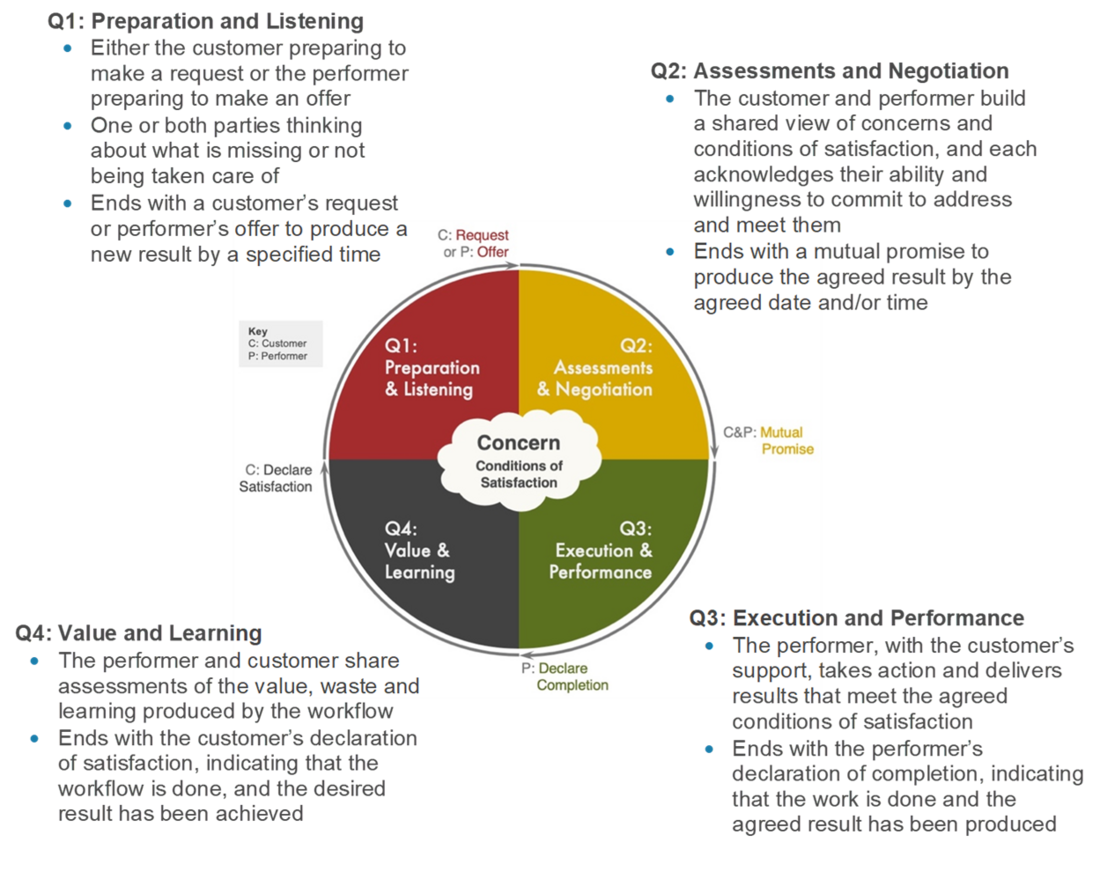
The workflow model reframes work as a conversation between a customer and a performer, collaborating to achieve a shared future driven by mutual concerns. This conversation unfolds across four quadrants, each playing a distinct role in producing value. After Preparation and Listening (Quadrant 1) establishes the foundation, Assessments and Negotiation (Quadrant 2) solidifies mutual commitments, and Execution and Performance (Quadrant 3) delivers the results, Quadrant 4 (Q4), Value and Learning, brings closure.
This fourth phase is about assessing the outcome, capturing insights, and strengthening the relationship for future collaborations. By mastering Q4, individuals can turn completions into opportunities for growth, reduce future waste, and build enduring trust, ensuring workflows evolve into a cycle of continuous improvement.
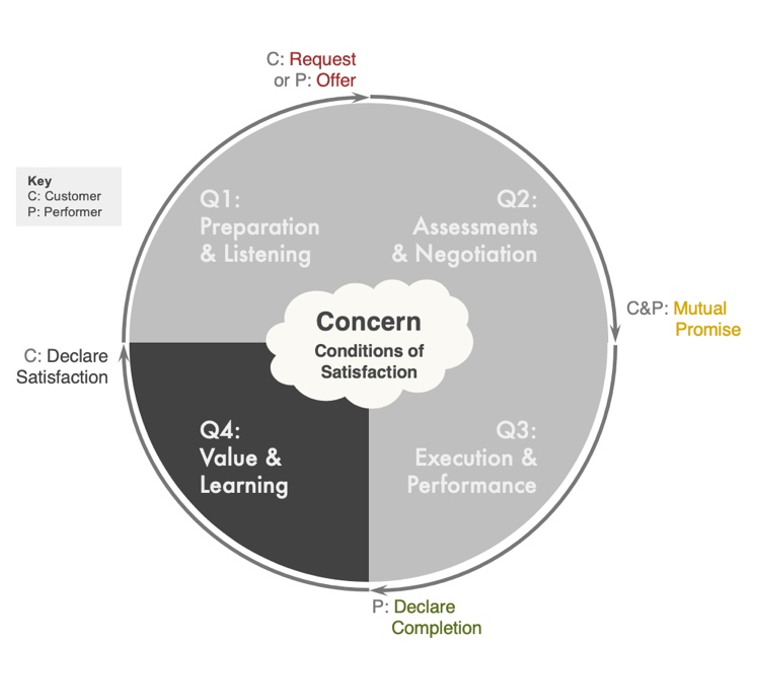
Q4 is the reflective capstone of the workflow cycle, where the customer declares satisfaction (or dissatisfaction) with the delivered result, and both parties evaluate the value created, lessons learned, and relational impact. Unlike the action-oriented Q3, Q4 focuses on assessment and dialogue, transforming the end of one workflow into the foundation for the next. Effective Workflow sees this as the phase where we "assess value delivered, what was learned and impact on relationship," emphasizing grounded evaluations over superficial feedback. It's not just about checking if the Conditions of Satisfaction (COS) were met; it's about exploring what worked, what didn't, and how the process affected both parties.
A hallmark of Q4 is its emphasis on mutual value, including the dual loop. While the primary workflow evaluates the customer's concern (e.g., a repaired car), the secondary workflow assesses the performer's needs (e.g., fair compensation or constructive feedback). This reciprocity ensures both sides feel valued, preventing resentment and fostering loyalty. For example, in the car service scenario, Q4 begins when the service representative (performer) declares the repair complete. The customer inspects the car, declares satisfaction, and both discuss the experience—perhaps noting efficient service or suggesting improvements like better communication about delays. This phase closes the loop, turning a transaction into a relationship-building moment.
Customer Responsibilities in Q4
The customer's role in Q4 is to provide honest, grounded assessments of satisfaction and contextualize the value received. Effective customers assess specifically to what extent they are satisfied, letting the performer know when they feel the work is finished. This involves more than a quick "thanks”. It's about articulating how the result addresses their central concern. For instance, in a project where a manager (customer) requested a report from a team member (performer), the customer might say, "This report fully meets our deadline and quality needs, helping us secure stakeholder approval." If dissatisfied, they ground their feedback in specifics, like "The data analysis was thorough, but the visuals didn't align with our branding guidelines, which impacts presentation effectiveness."
Customers also provide a larger context for the value of the result produced. This means linking the outcome to broader priorities, such as how a renovated home (from a contractor workflow) enhances family life or business operations. Ensuring any dissatisfactions and appreciations are well grounded, prevents vague complaints that erode trust. For example, rather than saying "It wasn't great," a client might note, "The logo design captured our brand essence, but the color palette needs adjustment for accessibility, here's why that's important for our audience." By declaring satisfaction clearly, the customer signals closure, allowing the performer to release resources and move on.
Additionally, customers contribute to mutual learning by sharing their perspective on the process. This includes appreciating the performer's efforts, which reinforces positive behaviors. In the car service example, the customer might express, "Your quick turnaround ensured I could make my trip without issues, thank you for prioritizing that." This acknowledgment strengthens the dual loop, addressing the performer's concern for recognition and repeat business.
Performer Responsibilities in Q4
The performer's role in Q4 is to initiate reflection by providing assessments and inquiring about the customer's views, ensuring a balanced dialogue. Effective performers provide assessments to the customer about what worked well and what didn't, what was learned and how future work will be impacted, what value and waste was produced, what new capital (if any) was produced, and how the relationship was affected. This proactive sharing demonstrates accountability and invites collaboration. For example, a graphic designer (performer) might say, "The design process went smoothly with your timely feedback, reducing revisions and saving time. We learned that incorporating mood boards early adds value—let's use that next time. The final logo builds your brand capital, but I noted some waste in sourcing unused fonts."
Performers inquire with their customer about their perspective on these points, asking the customer to reveal their level of satisfaction with grounded assessments. This might involve questions like, "How did this outcome align with your priorities? What could we improve?" In a corporate setting, a consultant delivering a strategy session might ask, "What value did this provide for your team, and how has it shifted your approach?" If dissatisfactions arise, the performer decides if they want to offer or accept a request for a new workflow to address them, perhaps proposing a follow-up session to refine the work.
Performers also capture assessments of value and learning as the work concludes, documenting insights for future reference. This ensures the workflow's end contributes to ongoing improvement, such as updating processes to eliminate waste. In the car service scenario, the representative might note, "The repair was efficient, but supply chain delays created waste—let's stock more common parts." By being clear about completion and seeking feedback, the performer reinforces trust and positions themselves for future opportunities.
Practical Applications and Tips
Mastering Q4 requires intentional practices to turn reflection into actionable insights. One key tip is to use each completion as a platform for building a stronger relationship. Schedule brief debriefs to discuss outcomes systematically. For simple workflows like the car service, this could be a quick survey or conversation at pickup. For complex ones, like a marketing campaign, use a structured template from the Workflow Worksheet (see linked document) to note what went well, what didn't, and next actions.
Another tip is to capture learning, value, and capital produced collaboratively. Both parties should build a mutual view of what worked well or didn’t, what was learned, value, waste, and capital produced. For instance, in a renovation project, document how the work created new "capital" like improved property value, while identifying waste such as unused materials. Provide specific appreciation to reinforce positives—e.g., "Your attention to detail on the fixtures exceeded expectations and added real value."
To diagnose Q4 issues, ask: "Have we fully assessed satisfaction and learning?" If relationships sour post-workflow, it may stem from skipped Q4, leading to unresolved dissatisfactions. In practice, integrate Q4 into routines: End meetings with a "value round" or log insights into a shared tool. For organizations, model Q4 in networked workflows, ensuring cross-team reflections to scale learning.
The Importance of Q4 in Workflow
Q4 is the workflow's linchpin for sustainability, as it transforms isolated transactions into evolving partnerships. Without it, workflows risk repeating errors, eroding trust, and missing growth opportunities. A strong Q4 captures value—tangible (e.g., a functional car) and intangible (e.g., enhanced confidence)—while reducing waste through lessons learned. It strengthens the relationship, making future interactions more efficient; a dealership with consistent Q4 feedback might streamline services, boosting customer loyalty.
The dual loop shines in Q4, ensuring mutual benefits. By addressing both parties' concerns, it prevents one-sided outcomes that breed resentment. In Effective Workflow, Q4's focus on grounded assessments and appreciation fosters resilience, enabling teams to handle complexity. For example, a missed deadline in Q3 becomes a learning point in Q4, improving future planning. Ultimately, Q4 elevates work from mere execution to a cycle of value creation, inspiring engagement and innovation.
Conclusion
Value and Learning (Q4) is where workflows achieve closure and renewal, turning results into insights that propel future success. By assessing satisfaction, capturing lessons, and providing appreciation, customers and performers build stronger relationships and mutual value. This phase isn’t an afterthought but a vital step that honors the effort invested across the quadrants. Whether wrapping up a car service or a major project, Q4 is your chance to reflect, grow, and prepare for the next conversation, ensuring workflows deliver lasting impact in a collaborative world.
Banner & thumbnail: .shock on iStock