VPP Market Participation in the NEM
Energy companies in Australia are developing innovative virtual power plant (VPP) offerings to customers. Whether it’s residential offers such as Amber for Batteries where customers pay the 5-minute wholesale electricity price while Amber helps charge and discharge the battery at the right time or range of commercial and industrial operators providing more bespoke and tailored offerings to their customers.
These offers not only improve customer outcomes but also system level outcomes through exerting downward pressure on wholesale prices and system service costs as well as improving system reliability.
But what are the underlying markets that VPP aggregators participate in to create much of this value? And what can we learn from different uptake rates in the various markets and schemes to inform future market design and regulation?
Contingency FCAS
Near the end of 2017 Distributed Energy Resources (DER) began participating in contingency frequency control ancillary services (FCAS), a market used to procure stand by capacity in case a large generator, load or interconnector were to trip. While contingency FCAS markets are a relatively small and niche market, DER was a natural fit due to:
Regulation
in 2016 the Australian Energy Market Commission made a rule[1] which removed barriers for small aggregated energy resources participating in contingency FCAS. Additionally, AEMO processes were updated to accommodate this new way to participate.
Capability
Industrial loads and batteries can provide almost instantaneous changes in output, and therefore are well suited to the lucrative “Fast Raise” market which requires a response over a 6-second period. Additionally, FCAS delivery doesn’t require real-time visibility from the market operator, simplifying the way the service is provided.
Incentives
Contingency FCAS costs had grown from $10m-$20m per year in the first half of the 2010’s, to $40m in 2016 and often breached $100m p.a. in subsequent years. With only a few hundred megawatts of FCAS required, this meant providers could earn upwards of $100,000/year for each MW of capacity they could reliably offer.
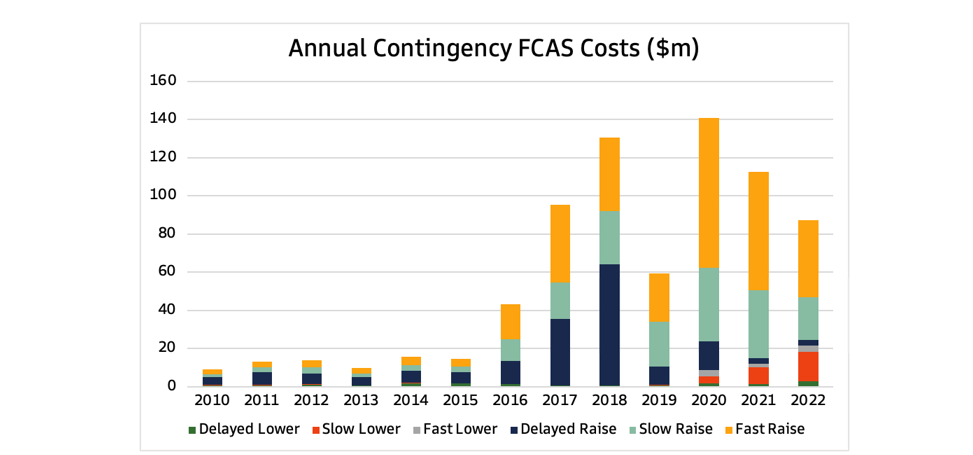
Source: AER Wholesale Statistics
With these factors aligned, the size of DER fleets quickly grew to provide around 20% of contingency raise FCAS in the NEM. This began with commercial and industrial capacity, largely from Enel’s global business line EnelX and then in 2019 residential battery capacity entered the market, led by retailers such as AGL, Simply and Energy Locals and specialised FCAS market participants such as Shinehub and Reposit Power.
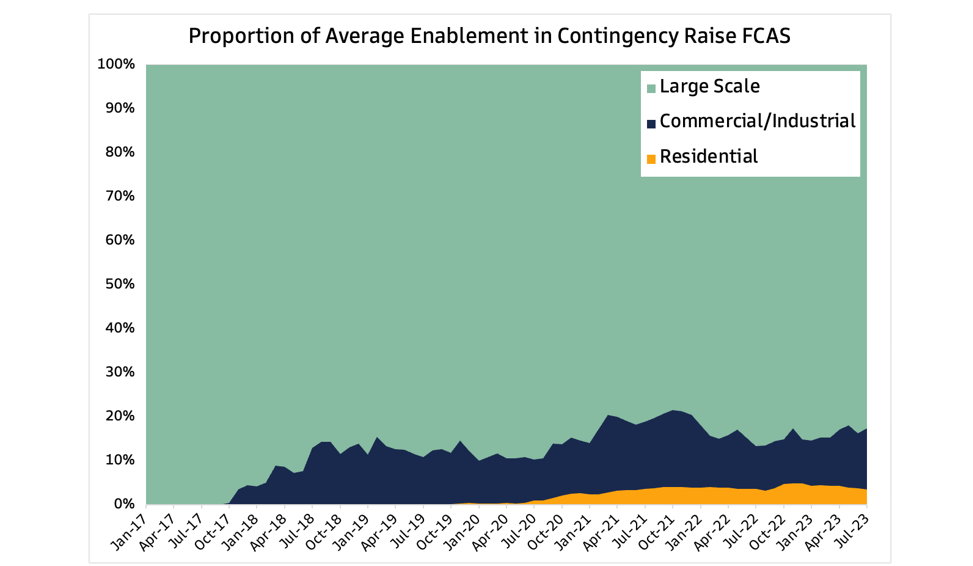
Source: AEMO Nemweb
Reliability and Emergency Reserve Trader
The Reliability and Emergency Reserve Trader (RERT)[2] is a provider of last resort capacity that allows demand response participation. Operators of unscheduled loads and generators (i.e. loads and generators which don’t actively bid capacity into the market) negotiate pre-agreed terms for providing demand response that the market operator can request when there is a potential shortfall in required generation in the energy system.
RERT is rarely called on, with most states requiring no RERT services each year, but when it is required, it can be extremely lucrative, in part due to operators being able to bid prices above the $16,600MWh wholesale market price cap.
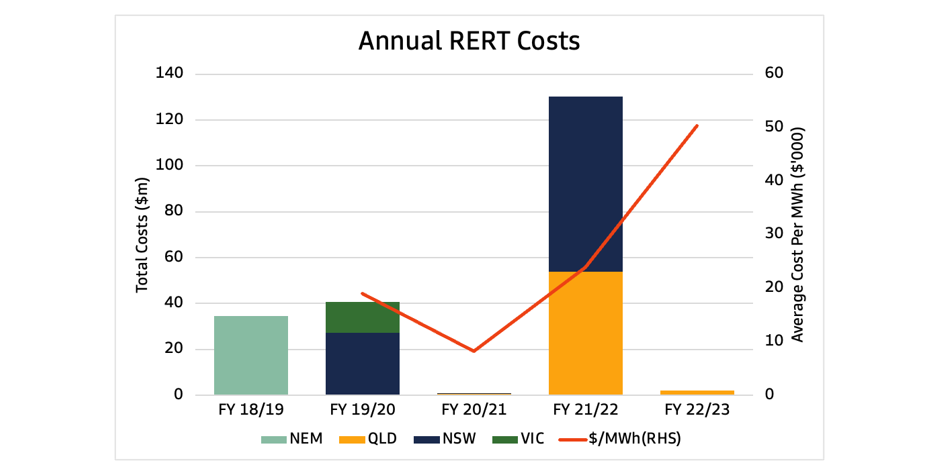
Source: AEMO RERT Reporting
(Note: AEMO did not provide regional breakdowns or costs per MWh in FY 18/19)
RERT is reasonably easy to operate in as it does not require integrating into market systems for bidding and operational purposes. Instead, contracts are negotiated bilaterally, delivery of the energy is done without real-time visibility from the market operator, and settlement and verification are carried out in relatively manual processes after the fact. Additionally, participants in RERT do not need to be energy market participants, which means the operators of demand response themselves such as industrial loads can directly participate.
Due to these features, and other factors such as ARENA and AEMO developing the market[3] through a $35.7M initiative we see a healthy amount of interest and competition in this mechanism. For instance, on 17 June 2022 AEMO contracted 1,288 MW of capacity from 16 different participants ranging from residential VPP operators, commercial and industrial demand response through retailers and direct participation from large manufacturers such as Visy, Portland Aluminium Smelter and Bluescope Steel. While on this day the capacity was contracted but not ultimately dispatched, when capacity is activated these companies and their customers can earn large windfalls:
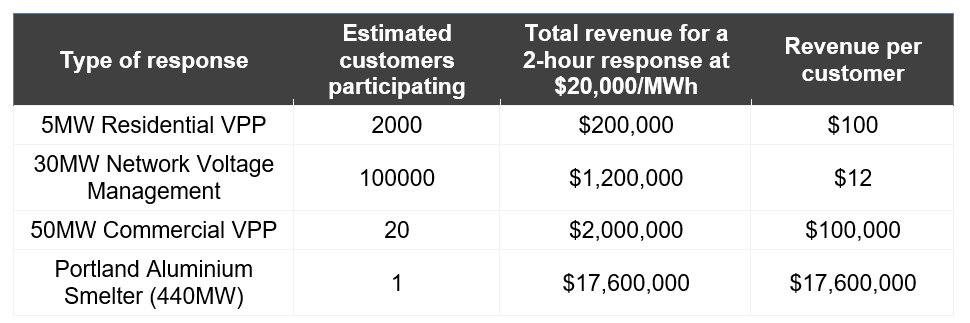
Examples of RERT revenue in a range of scenarios
Wholesale Demand Response
Whole Demand Response (WDR) allows for a market participant separate from the retailer to bid demand reduction capacity into the market during high prices. This allows energy users to be on a standard energy contract with a retailer, but to be rewarded from a separate party when they reduce their output during high wholesale prices.
WDR is arguably more lucrative than RERT since high market prices, which WDR can respond to, are far more frequent than power system reliability risks that active RERT.
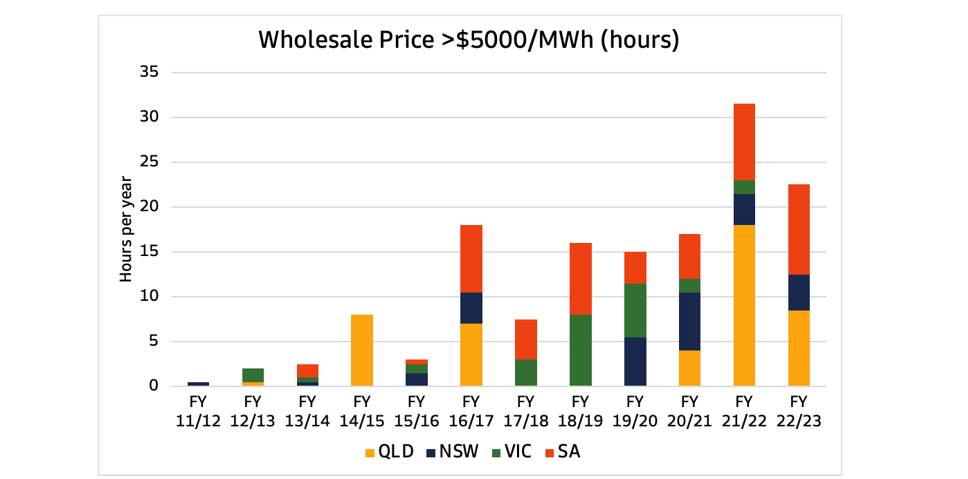
Source: AER Wholesale Statistics
WDR does require a complex integration into the market operator’s systems with bidding, dispatch and real-time visibility requirements similar to that of much larger scheduled generators. Additionally, this mechanism requires a specialised market participant and is only accessible to “large customers”, ruling out participation from residential energy users.
To date WDR has seen meagre uptake, with a total of 67MW of register capacity by a single provider. How much this is to do with the high registration constraints and operational requirements or just the early nature of this mechanism, will be seen during the coming years.
Unscheduled Demand Response
While we have covered the three primary ways in which DER and VPPs can directly participate in markets and mechanisms by offering capacity through an auction system with subsequent dispatch and visibility requirements, a large amount of flexible DER operates as “unscheduled demand response”. Due to the NEM being a real-time energy only market, if the 5-minute spot price goes high, demand response can simply reduce output or increase generation to profit from this volatility. While there is often an agreement and coordination between the retailer and energy users providing this demand response, often no other parties are fully aware of how much this capacity is or where it may be used.
A 2021 study by Energy Synapse[4] examining the “Demand Side Participation Information (DSPI) portal” found that there was over 4GW of registered demand response capacity from a range of sources, which trigger at a wide range of prices. This though is just registered capacity. It’s unclear how much of this 4GW is active and how much capacity responds to the wholesale spot price but has not registered.
The Australian Energy Market Commission (AEMC) is considering how it can make this demand response capacity more visible and transparent to the market through the “Integrating price-responsive resources into the NEM”[5] rule change consultation.
New Opportunities
As the NEM transitions there will be new markets, mechanisms and incentives that VPPs could participate in.
For instance the NSW Long Term Energy Service Agreements, a form of capacity payment, does allow for demand response and VPPs[6] but they currently must be scheduled in the WDR. The current federal consultation paper[7] on their capacity investment scheme seems to only allow for large scale utility assets.
New system level markets are emerging, such as the new very fast contingency FCAS market[8] which will test the ability of VPP assets to respond in hundreds of milliseconds to frequency disturbances as well as the ongoing consideration by the rule maker of operating reserves[9] and inertia markets[10].
And finally, local network support may grow as a viable but small revenue stream as the locational density of VPPs increase and changing usage profiles increase constraints on the network. How VPPs can be compensated for supporting the local network are being explored in tariff trials[11], improved processes to procure network support and even a trial testing 5-minute dynamic network prices[12] to reflect local congestion on the network.
Conclusion
To date VPPs in the NEM have earned market revenues through relatively low hanging fruit, either lucrative but shallow markets such as contingency FCAS or easy to participate in structures such as unscheduled demand response and RERT. As fleet sizes increase, and new markets develop, the capabilities of VPP operators will need to increase to continue to access lucrative revenues and opportunities for their customers' assets to participate in.
VPPs offering underutilised or low-cost capacity into markets reduces the reliance on expensive new and existing peaking capacity, improves system resilience and puts downward pressure on wholesale prices and system service costs. A study commissioned by the Australian Energy Renewable Agency[13] estimates a potential “$8-18 billion in savings from demand flexibility due to the reduced investment requirements for large-scale generation and storage capacity” which can be realised through increased market integration in conjunction with other levers such as tariff reform and supportive state and federal policies.
About Mitch O’Neill

Mitch O'Neill is a Principal Consultant at Grids Energy helping companies and governments navigate and find opportunities in the energy transition. He's been involved in distributed energy resources since 2015 with software and strategy roles at battery aggregator Reposit Power, developing DER policy at the Energy Security Board, and various roles with distribution network businesses.
- [1] www.aemc.gov.au/rule-changes/demand-response-mechanism
- [2] aemo.com.au/en/energy-systems/electricity/emergency-management/reliability-and-emergency-reserve-trader-rert
- [3] arena.gov.au/news/aemo-arena-demand-response/
- [4] energysynapse.com.au/product/demand-response-in-the-national-electricity-market/
- [5] www.aemc.gov.au/rule-changes/integrating-price-responsive-resources-nem
- [6] aemoservices.com.au/-/media/services/files/publications/market-briefing-4/224213-aemo-briefing-notes-firming-infrastructure-v2_con5.pdf
- [7] consult.dcceew.gov.au/capacity-investment-scheme-public-consultation-paper
- [8] aemo.com.au/en/initiatives/major-programs/fast-frequency-response
- [9] www.aemc.gov.au/rule-changes/operating-reserve-market
- [10] www.aemc.gov.au/rule-changes/efficient-provision-inertia
- [11] www.aer.gov.au/networks-pipelines/network-tariff-reform/tariff-trials
- [12] www.ausgrid.com.au/About-Us/Future-Grid/Project-Edith
- [13] arena.gov.au/knowledge-bank/valuing-load-flexibility-in-the-nem/
Suggested content