Assessment, Prevention and Mitigation of Safety Risk in Cable Systems
Safety in cable systems is no longer a peripheral concern—it is central to responsible engineering, corporate governance, and sustainability. The CIGRE Working Group B1.86 has developed a comprehensive Technical Brochure (TB) titled Assessment, Prevention and Mitigation of Safety Risk in Cable Systems, addressing the full lifecycle of both underground and submarine cable systems. This work aligns with CIGRE’s strategic focus on Environment, Sustainability, and Governance (ESG), emphasizing human safety as a core component.
The brochure responds to the increasing demand for structured safety risk management in cable systems, building upon the foundational work of WG B1.71. It identifies gaps in existing literature and CIGRE publications and offers practical guidance for stakeholders across the industry—from manufacturers and installers to utilities and offshore developers.
Members
Convenor (BR)
Julio LOPES,
Carl Erik HILLESUND (NO),Christopher DONAGHY-SPARGO (GB), Uberto VERCELLOTTI (IT), Ricardo GOMEZ (ES), Toni WUNDERLIN (CH), Grazia BERARDI (IT), Harry ORTON (CA), Imane KAMAL (FR), Jan MARKHOFF (DE), Sander MEIJER (NL), Paolo LABINI (IT), Peter TIRINZONI (US), Frédéric POCHAT (FR),Yuichi OSADA (JP), Xiaofeng XU (CN), Vusi CELE (ZA), Ryosuke ISHII (JP), Zoltán Ádám TAMUS (HU), William Leong (AU)
Corresponding Members
Nic MOFFA (AU), Russell CATHCART (NZ)
Introduction
Energy production from the Renewable Energy Sector (RES) and the interconnection between power grids is an area of rapid expansion all over the world, and electric energy demand increases in the largest metropolitan areas, particularly in the developing countries. However, construction of new overhead transmission lines is becoming increasingly difficult due to social opposition and challenges to obtain approvals and permits – an example is the German Transmission System Operators (GTSO) project.
As a result of these constraints, alternative solutions are required to increase transfer capacity between critical power grid sections, such as underground power cable interconnections and submarine cable systems.
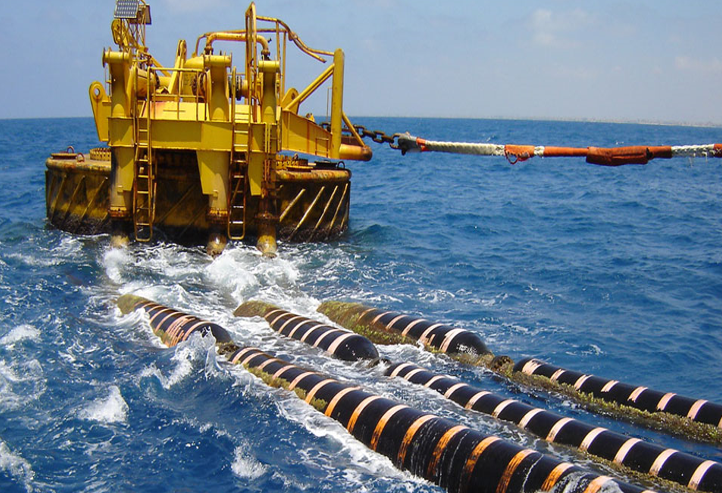
Example of submarine cable installation
(source Prysmian)
In addition, the consequences of climate change with more frequent and intense storms, floods, heat waves, wildfires and other extreme events will consequently require the use of more underground cable networks which are inherently more resilient to climate‑related hazards.
The increasing number of installations of insulated cable systems, both underground and submarine, driven by the needs mentioned above, increases the hazards and safety risks associated with the activities inherent to these installations.
Underground power cables undergo numerous quality control tests during manufacture such as type, pre-qualification, routine, sample, and commissioning tests (after laying or on-site tests). These tests are essential because the installation of accessories (terminations, clamps, and joints) introduces the human factor into the cable system, making commissioning and on‑site tests particularly important.
Utility technical specifications, often included in tender documentation, introduce diagnostic tests such as partial discharge (PD), time‑domain reflectometry (TDR), AC withstand, and dissipation factor measurements to evaluate the quality of the complete cable system.
Handling procedures during manufacturing, transportation, installation, site acceptance testing, commissioning, operation, maintenance, repair, and eventual dismantling or decommissioning — require special focus to introduce generic methods and best practices to avoid or mitigate safety risks during every lifetime phase of both land and submarine cable systems. The assessment prevention and safety risk mitigation must be also considered during the planning, design and engineering phases of the project.
Scope and Methodology
The scope of the brochure is broad yet focused. It covers safety risks in insulated cable systems—both underground and submarine—across all lifecycle phases, from planning and design to decommissioning. The primary concern is human safety, though environmental and ecosystem risks are acknowledged.
The objective is to provide guidance on how to reduce accidents and hazards for personnel and prevent damage to system components. Members of the Working Group contributed with reports of past events and real accidents by sharing experiences of the participating countries, enabling efficient and successful collection of information and lessons learned.
A previous Working Group of the Study Committee B1 (SC B1) evaluated all documents published by the SC (Technical Brochures, Electra Magazine, Special Reports,...
ELECTRA, is the digital magazine of CIGRE, you can obtain access as part of a CIGRE membership. Find out more about joining options here.
Other Technical Brochures