User Guide for Non-SF6 Gases and Gas Mixtures in Substations
CIGRE Technical Brochures 802, 849 and 871 provide broad knowledge on the application of non-SF6 gases in gas-insulated switchgear, their dielectric performance and the current-interruption behaviour in non-SF6 gases.
IEC 62271-4 was published in 2022 as one of the first international standards describing gas handing procedures for different gases for insulation and/or switching which are currently available on the market. Furthermore, IEC 63360 has been published, and IEC 63359 is under development to specify the requirements for technical grade and reuse grade non-SF6 gases and gas mixtures.
Meanwhile, IEEE standards and guidelines like C37.123, C37.122.10, C37.1.122 and C37.100.7 which are related to the application of non-SF6 gases and gas mixtures are evolving.
Members
Convenor (NL)
Piet Knol
Secretary (DE)
B. Lutz
Shinya Aichi (JP), Roland Kurte (DE), Viorel Badicu (DE), Billy Lao (US), Matthew Barnett (GB), Andres Laso (US), George Becker (US), Diana Leguizamon (FR), Hugo Brummelhuis (NE), Logan Rolles (US), Saskia Buffoni (CH), Frédéric Loray (FR), Addison Gabriel (AU), Peter Pilzecker (DE), Michael Gatzsche (CH), Karsten Pohlink (DE), Terry Gordon (CA), Koma Sato (JP), Neil Gwinnutt (GB), Daniel Schiffbauer (US), Hiroyuki Hama (JP), Matja Simon (PL), Maik Hyrenbach (DE), James Stage (US), Michael Inversin (FR), Junot Suffeleers (BE), Jesus Izcara (ES), Raimund Summer (DE), Alain Jeanmaire (FR), Shigeyuki Tsukao (JP), Karsten Juhre (DE), Toshiyuki Uchii (JP), Jun Jiang (CN), Karthik Reddy Venna (DE), Achim Kalter (DE), Mark Waldron (GB), Kyon-Hoe Kim (KR), Wen Wang (CN)
The brochure covers
- two gas mixtures containing fluorinated compounds (F-gases) for use for insulation and interruption in gas circuit-breakers and
- natural-origin gas mixtures (NOGs) for use with gas interrupters and vacuum interrupters.
It provides a practical guide for users of non-SF6 gases and gas mixtures as well as practical information in addition to the procedures given in IEC 62271-4. Moreover, this brochure describes “best practices” for non-SF6 gases and gas mixtures regarding
- gas handling procedures
- gas handling equipment
- gas measurements
- tightness requirements and tests
- environmental, health and safety requirements
- end-of-life treatment and recycling requirements
For the topics listed above, special reference is made to the state-of-the-art knowledge of SF6 applications, i.e. CIGRE Technical Brochures 234 (SF6 recycling guide), 276 (SF6 handling guide) 430 (SF6 tightness guide) and 723 (SF6 measurement guide). If applicable, differences between non-SF6 applications and SF6 applications are explained in this userguide.
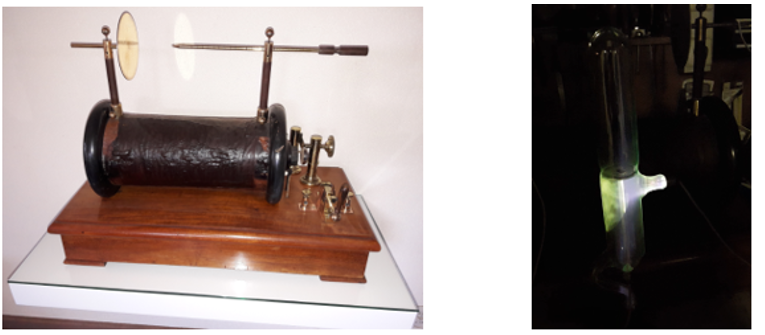
Photos: Ruhm Kroff coil, Geisler tube, private collection – “dielectric studies”
Gas handling
Today, all necessary handling equipment to handle the gases and gas mixtures covered in this brochure is available on the market. When handling non-SF6 gases and gas mixtures in high-voltage switchgear, filling on site can be done either with bottles of pre-mixed components (in a gaseous or partly liquid state) or with individual bottles of pure components and a gas-processing cart. Gas-handling equipment is available for filling, top-up and recovery, for leak detection and leak location as well as for gas quality checks.
Although some devices can be used for multiple gases, users should ensure that equipment dedicated for the specific non-SF6 gas or gas mixtures is applied. To distinguish between different gases, the use of different connections and colours on the valves and handling equipment is recommended and some examples are given in this brochure. The same commissioning methods used for SF6 apply for alternative mixtures. Top-up methods are described in IEC 62271-4, like adding one component of a mixture or adding a technical grade mixture. It is for the user to decide on the amount of gas and handling equipment to be stored.
Gas measurements
Unlike SF6, non-SF6 gas mixtures consist of several gases. typically at higher pressure to keep the same dielectric performance and with lower mass density, because natural-origin gases like CO2, O2 or N2 often form the main part of the mixture. The use of gas mixtures introduces the need for gas concentration measurements to verify that technical requirements defined by the original equipment manufacturer and by IEC standards are fulfilled.
Due to real-gas effects in such mixtures, e.g. at low temperatures, it is recommended that concentration measurements are performed using the unit mol% instead of vol% to guarantee comparability among measured values. Regarding humidity, the IEC requirement for a frost-point below -5 °C is also applicable to non-SF6 gas mixtures. Practices for pressure or density monitoring are unchanged. Mobile analysers are available on...
ELECTRA, is the digital magazine of CIGRE, you can obtain access as part of a CIGRE membership. Find out more about joining options here.
Other Technical Brochures