Power system restoration accounting for a rapidly changing power system and generation mix
Many power systems around the world are experiencing a rapid uptake of inverter-based resources (IBR), both in the form of large-scale generation and distributed energy resources (DER). This often coincides with a reduction in the number of online synchronous generators. IBRs and synchronous generators have different performance characteristics from several perspectives including the dynamic performance, and most notably the black start performance.
Members
Convenor
(AU)
B. BADRZADEH
C. NORONHA (AU), D. SPOOR (AU), S. ZABIHI (AU), P. VAN MEIRHAEGHE (BE), A. GUARINI (BR), R. GUNASEKARA (CA), L. KOTHALAWALA (CA), R. LIU (CN), P. HINKEL (DE), R. KREBS (DE), A.-J. NIKKILÄ (FI), M. AGUADO (FR), D. AUTY (GB), D. GUTSCHOW (GB), S. MCGUINNESS (IE), P. MUKHERJEE (IN), R. PORWAL (IN), H. PUSTJENS (NL), I. HANST (NL), M. BULUT (TR), N. NZUZA (SA), M. HIGGINSON (US), C-C. LIU (US), V. SINGHVI (US)
Interactions between various power system components, both the primary and secondary (protection systems), pertaining to system restoration are generally more complex than those occurring during day-to-day operation and system intact conditions. These interactions are becoming more complex as the IBR share increases in the power system due to their use of more sophisticated and flexible control systems.
The complexity of the interactions due to changes in generation mix is compounded by the impact of the extensive role played by power electronics and the adoption of a broad range of sensors across the power delivery system and information technologies for real time management. As the relationship between the physical grid and IT systems becomes intertwined. This, in turn, means the increasing importance of accounting for cyberattacks from the standpoints of system restoration planning and operation.
Black start capability is provided by generators with the capability to start, or remain in service, without electricity being provided from the grid. These generators must then energise sections of the transmission and distribution networks, and restart other large generators as shown in Figure 1. Ultimately loads connected to the distribution system and lower voltages are picked up. Not all synchronous generators come with system restoration capability, and the vast majority of currently installed IBRs do not have this capability. As such to date IBRs have often played a relatively small role in initiating or supporting system restoration. However, this will not be feasible moving forward as IBRs are becoming the main source of generation in many power systems worldwide. Another key change impacting system restoration is increased interactions between the transmission and distribution systems, a key contributor to which is the increased uptake of the DER.
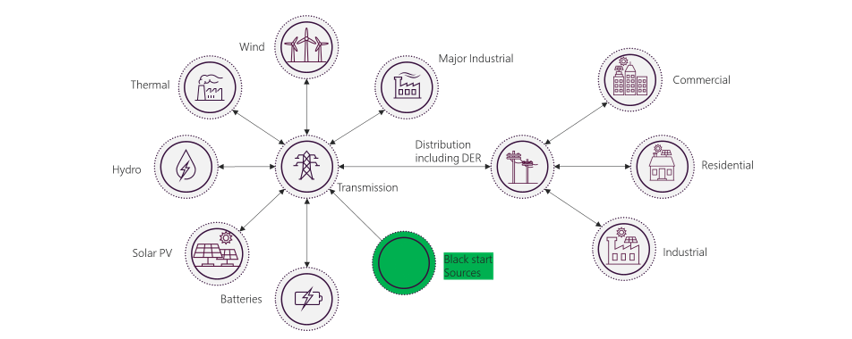
Figure 1 - Power system components involved during system restoration as the power system and generation mix change
While rare, the extent of the impact of blackout events is such that acquiring a specific quantity and quality of black start sources is essential as it enables timely restoration of supply following a major supply disruption including a black system event. Furthermore, the frequency and severity of such events have been increasing in recent times due to the impact of climate change and aging infrastructure among other factors. The continued security of the power system, at the lowest cost to consumers, is possible only if sufficient black start sources are in place. Without such a capability there is no guarantee that the power system can fully recover even within days after a major supply disruption. Whilst enhancements in system resilience reduces the likelihood of a blackout, it cannot eliminate the risk of a blackout and its consequences. The provision of black start capability therefore remains an essential part of ensuring the overall system resilience during the energy transition because of the impact of IBRs.
System operators develop plans, procedures, and resources available to restore the power system following a partial or total shutdown. Successful power system restoration requires the use of a wide range of complementary analytical tools. These range from determining power system restoration in a planning horizon of several years ahead, to reliable implementation of restoration plans in the event of an actual blackout, and the ability to deal with situations where the actual system undergoing restoration is not identical to those used for developing restoration plans. A rigorous way of identifying and assessing potential interactions between power system equipment is to undertake detailed computer modelling and analysis encompassing all generators and sections of network involved during the restoration. A higher level of details is required for this modelling compared to planning, generator connections and operational planning studies. The complexities of generation mix and IT point towards a need for planning, including data and modelling, training, and system-wide exercises and implementation of flexible system restoration. New tools and techniques for offline simulation and control room applications and training in using them has never been as important as now.
The Working Group C2.26 aims to identify emerging risks on system restoration, investigate opportunities for increased utilisation of new and emerging technologies during system restoration, and enable system operators and network owners to continue executing a successful system restart as required in an environment of rapidly changing generation mix. Key considerations in this WG are lessons learned and actions taken from recent blackout events, the role of grid-following and grid-forming inverters in system restoration (either as a black starter or to support system restoration), positive and negative impacts of distributed energy resources, physical testing of black start capability at the system level, the impact of cyberattacks on system restoration, and tools and techniques for analysing system restoration including modelling and simulation of black start capability.
Key learnings from this WG are summarised blow.
IBR role during system restoration
Both the grid-following and in particular the grid-forming inverters can have a much more substantial role during system restoration than they currently have, including in both grid and supply reconstruction. The use of the grid-forming inverters, in particular using battery energy storage systems (BESS), was presented with both the simulation studies, and practical examples of testing and their ongoing use not just to self-start themselves but to perform the functions that a synchronous generator can fulfil in terms of energising wider power system and other generation. The TB has also discussed the criteria for deciding on how to progressively bring online grid-following inverters such as wind farms and lime commutated converter (LCC) HVDC links to ensure their stability can be maintained.
The impact of distributed energy resources
DER (in particular the non-controllable forms) can cause two significant challenges during restoration load pick-up including both during very early stages (cold load pick-up) and subsequently as more loads are picked up.
- Reducing the load required for stable operation of large synchronous generators, especially coal fired stations. At the worst case if DER offsets significant load, synchronous generators would need to be turned off to match the net load conditions.
- De-stabilising impact of non-controllable DER on synchronous generators during cold load pick-up such that a synchronous generator could suddenly pick up a much larger DER size than the load connected to the same feeder.
These mean that with significant penetration of DER such as DPV, certain restoration pathways may not be possible, and restart may eventually become impossible during daylight hours unless mitigation measures are implemented. Detailed modelling and analysis including considerations for the control system response of IBR-based DER and option development for the mitigation measures required is therefore crucial as otherwise system restoration could be severely impacted.
However, it is important to note that DER can also be utilised to assist during system restoration, especially larger units whether synchronous or IBR-based. This approach has already been applied in the UK details of which were presented in the TB.
The need for clear and upfront technical performance requirements
Understanding power system restoration needs, with rapidly changing power systems and generation mix, will provide insight into the necessary modifications in the design of new IBRs yet to be connected. Retrofitting the capability after a few years will be significantly more expensive if possible at all. The same applies to network elements, such as protective relays. There is a need to develop more specific technical and regulatory requirements, grid codes and tariffs for the expected performance of grid-forming and grid-following inverters during system restoration. This is recognising that black start conditions are vastly different and more onerous compared to system normal conditions, and as such additional capabilities, beyond the self-start ability, will likely be required which are not needed during normal operating conditions. It is also important to identify the extent to which IBR will need to emulate the natural and inherent response of a synchronous machine during system restoration, avoiding expensive and unnecessary cost of additional hardware for the IBR.
Importance of physical testing of system-wide restoration capability
Several examples were presented in the TB signifying the importance of conducting black start tests to assess the collective capability of the black start source and the surrounding network rather than focusing on the black start source only. Most case studies presented uncovered some unknowns and teething issues whose resolution permitted system operators to repeat the tests successfully. Identifying such network and generator interaction issues during an actual blackout event could be very costly potentially hindering the successful implementation of restoration plans.
Impact of cyberattacks on system restoration
System operators and other parties are developing and implementing sophisticated IT-solutions not only to make and keep this complex system working but also to find the limits for maximum use of the system. Most of these systems are interacting with each other or with systems connected to the transmission system leading to a complex Cyber-physical system (CPS). These complexities are further exacerbated by changes in the generation mix and consumer preferences among other factors. The risk of a serious interruption of the power is increasing for the following reasons:
- Increasing cyber threat towards critical infrastructures including the electricity system, especially by state-backed actors.
- Increasing attack surface. The fast digitalisation of the transmission system and the expanded system services offer an increasing variety of attack possibilities.
- A cyber-attack is not the only threat of an increasing number of (complex) cyber systems. They can also fail due to software bugs or human errors.
- The complexity of the system and the high dependency on cyber systems makes the operation of the system without these cyber systems already highly difficult.
Increasing need to perform detailed power system modelling and simulation
Fundamental to analysing most phenomena during system restoration and developing system restart plans are offline electromagnetic transient (EMT) simulation tools. These tools have been very widely used worldwide for black start studies, because the key phenomena of importance cannot be studied adequately with other simulation tools. Increased uptake of IBR and their more complex dynamic responses would further necessitate the need for EMT modelling. The need for additional studies when integrating IBR in system restoration was discussed, and several simulation case studies were presented. Similar to the physical testing of system-wide black start capability, the use of wide-area EMT simulation was shown to be an effective tool in pre-emptively identifying teething issues and make the necessary modifications to avoid the occurrence of such issues in practice. Modelling and simulation, and physical testing can be used complementarily where simulation results can be validated against the actual test results, and thereafter using the simulation models to assess some of the what-if scenarios which may not be practicable to test in the real system.
Wide-area EMT models comprising up to several hundred dynamic models and several thousand busbars have been successfully developed and tested. These wide-area models will be very useful for assessing interactions between power system equipment during system restoration especially as the system dynamics become more complex as mentioned above.
The advantages and applications of real-time simulation (RTS) – including the use of hardware-in-the-loop approach allowing a hybrid use of simulation models and hardware – were discussed, and a few examples were presented including the use for testing relay performance during system restoration.
Control Centre applications
Faster and more informative analytical tools with focus on Control Centres were then discussed. The tools include wide area monitoring system (WAMS), dynamic security assessment (DSA), operator training simulator (OTS) and RTS. Practical examples of using these tools for system restoration purposes are currently limited. However, rapidly changing power system and generation mix worldwide should encourage the development and use of such tools to better understand and manage their impact on various aspects of power system technical performance during system restoration.

Other Technical Brochures