Public participation in project development and the celtic interconnector
On a late November morning in Paris in 2022 the Irish Taoiseach Micheál Martin, Irish Minister for Environment, Climate and Communications Éamon Ryan, and French Minister for Energy Transition Agnès Pannier-Runacher met representatives from EirGrid and Réseau de Transport d'Électricité (RTE), the Transmission System Operators (TSOs) of Ireland and France respectively. The meeting celebrated the signing of the engineering, procurement and construction (EPC) contracts for the delivery of the Celtic Interconnector by Siemens Energy and Nexans.
by Morgan O’Sullivan, EirGrid
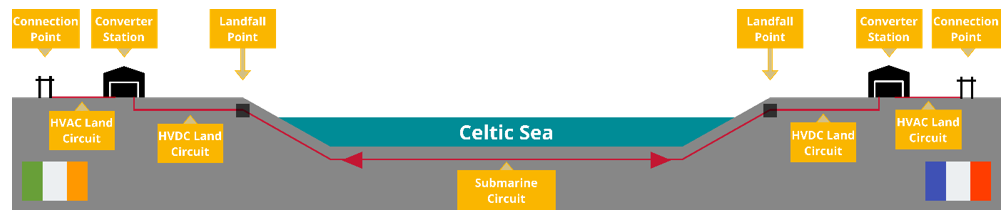
The Celtic Interconnector is a high voltage direct current (HVDC) interconnector being developed jointly by EirGrid and RTE between the village of Knockraha in County Cork in the South of Ireland, and the commune of La Martyre in Brittany in the North-West of France.
The project was designated by the European Commission as a Project of Common Interest (PCI) under the Regulation for the Trans-European Energy infrastructure (TEN-E). The project is part-financed by the European Union with a grant of €530 million through the Connecting Europe Facility. The interconnector represents a significant investment in the Irish and French energy systems, with a forecast total cost of the project of approximately €1.6 billion.
The Celtic Interconnector will be the first direct electrical connection between Ireland and mainland Europe and following the United Kingdom’s exit from the European Union (EU), the Celtic Interconnector will be the only electrical connection from Ireland to another EU member state. The project will benefit both Ireland and France through allowing increased integration of variable renewable energy sources in each country to help achieve their emission reduction targets, increasing energy security, and reducing peak energy prices resulting in mutual benefit for Irish and French consumers and businesses.
Construction began in January 2023 and the project is on track to be energised in 2026.
Source: EirGrid
The Celtic Interconnector will consist of a symmetrical monopole 570 km ±320 kV direct current cable link between AC/DC converter stations in Ballyadam, Cork, Ireland and Ar Merzher, Brittany, France. The DC cables will be aluminium cross-linked polyethylene (XPLE) cables, with 497 km of the route being subsea, and all cables will be supplied by Nexans. When built the Celtic interconnector will be the world’s longest XPLE interconnector. The AC/DC converter stations will be Modular Multilevel Converter architecture Voltage Source Converters using Siemens Energy HVDC PLUS technology. Each converter station will be connected at 400 kV AC to the wider Irish and French AC transmission systems. In addition to the electrical link, a parallel fibre optic link will be installed for control and protection and communication.
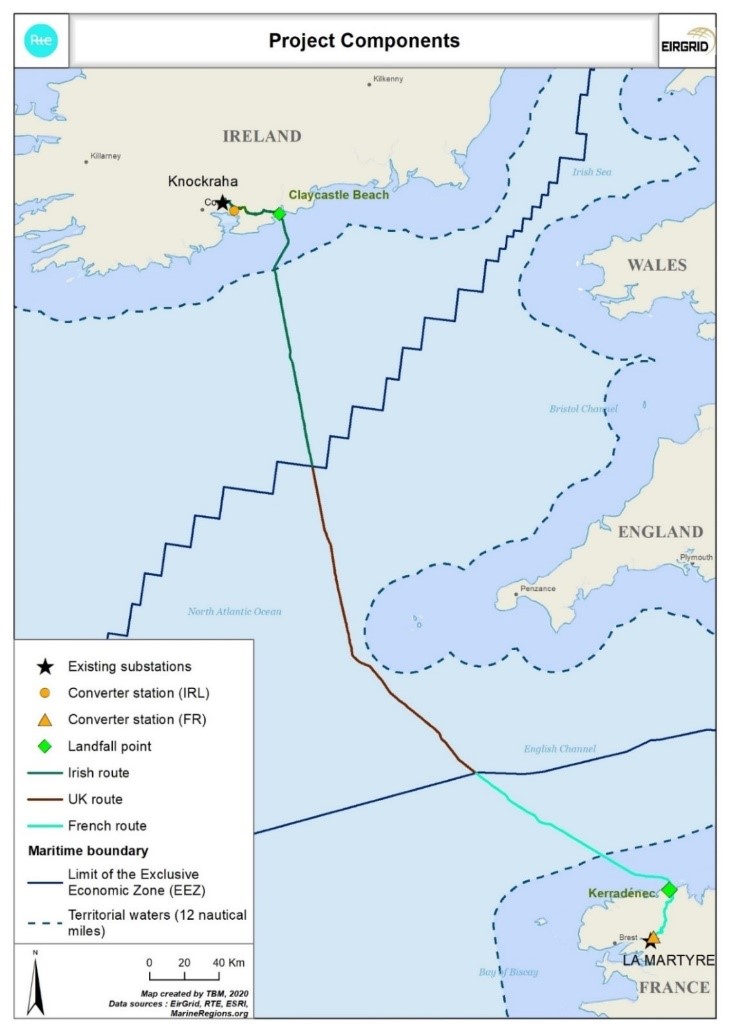
A key challenge of a multijurisdictional project such as the Celtic Interconnector is obtaining all consents, authorisations and licenses necessary for the surveying, construction, testing and enduring operation of the interconnector from each of the relevant authorities and bodies. The Celtic Interconnector required authorisations in three national jurisdictions. The project required authorisations in Ireland and France at each end and due to a 211 km section of subsea cable which will pass through the United Kingdom Exclusive Economic Zone (EEZ), also required licenses from the UK.
Across all three national jurisdictions over 30 consents, authorisations, or licenses were required. These were a mix of consents for development on land and at sea, licenses for marine surveying activities and all activities ancillary to the project on land, and authorisations for construction and operation of high voltage electricity infrastructure.
On land in Ireland and France consents were required from the respective planning authorities for the land cable route and converter stations. Additionally, marine consents were required for the cable and laying of the cable and any required protection in the territorial waters of Ireland and France, and in the EEZs of Ireland, the United Kingdom, and France.
Source: EirGrid, RTE
Throughout the development phase of the Irish portion of the project, EirGrid followed its Framework for Grid Development process, which was developed in 2017. This is a six stage process based on values of social responsibility, integrity, and transparency which sets out to consult stakeholders and communities at each stage of project development. The benefits of this new framework were immediately seen with local stakeholder and community engagement events being held for the Celtic Interconnector project in County Cork, Ireland as early as 2017, with confirmation of the point of connection to the onshore transmission system.
Following the completion of the feasibility phase, the detailed design and consents phase of the project ran in parallel with a joint RTE – EirGrid procurement process to run a tender competition for the project in order to accelerate project delivery timelines. Following extensive pre-tender supplier engagement and a pre-qualification stage two EPC contracts for the HV AC/DC converter system and the HVDC and HVAC cable systems were tendered in the Official Journal of the European Union (OJEU) in 2020 kicking off the first round of the procurement process.
As the detailed design and consents phase progressed the options for each Irish aspect of the project were narrowed down to a final best performing option for converter site, landfall point and AC and DC cable routes through multi-criteria analysis by EirGrid, which took stakeholder views and concerns which had been gathered through public consultation into account.
In July 2021, EirGrid made a consent application for the onshore development in Ireland to the central Irish planning authority, An Bord Pleanála (ABP), who are responsible for consenting of Strategic Infrastructure Development. The planning application included a comprehensive Environmental Impact Assessment Report (EIAR) and Natura Impact Statement (NIS – relating to Appropriate Assessment) to ensure the impacts on the local environments, ecology, and biodiversity were minimised and mitigated against. It also included a Joint Environmental Report, which presented and assessed the cumulative impact of the entire project across the Irish, French, and British sections.
EirGrid and RTE drew on inputs from stakeholders and communities on land and at sea, including local fisheries, which had been gathered through the consultation process and produced the Joint Environmental Report to provide additional information to, and alleviate the concerns of, stakeholders and communities affected by the project in Ireland, France, and the UK EEZ.
The work of the teams in Ireland and France resulted in the successful granting of the consents for the Irish elements of the interconnector by ABP in 2022. The principles of integrity and transparency EirGrid applied in public participation and stakeholder and community engagement throughout the project development process resulted in the granting of the Irish consents with minimal submissions from stakeholders, communities, or the public at large. Additionally, no legal challenges have been brought against the granting of Irish consents for the project.
Like with all large projects, the Celtic Interconnector project success is due to the hard work of many people across many teams and companies in several different countries. However, also key to the success of the project is EirGrid’s Framework for Grid Development process and the extensive engagement undertaken in good faith throughout the project development process with stakeholders and local communities. This culminated in the expeditious granting of the Irish consents preventing any delay to the project and keeping the interconnector on track to be energised in 2026.
Thumbnail credit: Patrick Metzdorf on Unsplash
Suggested content