Evolving power systems, addressing stability needs before it is too late
Power systems are facing fundamental changes in their dynamics due to the introduction of power electronic devices, which are crucial for the energy transition. Adverse interactions have been increasingly reported worldwide indicating that power system's stability needs are not always met. We emphasize that stability at high frequencies should be ensured in a future-proof, scalable and efficient way by guaranteeing that new devices do not decrease damping in the high frequency range.
by Ozgur Can Sakinci, Thomas Roose, Francesco Giacomo Puricelli, Eros Avdiaj, Francisco Javier Cifuentes Garcia, Jef Beerten
Department of Electrical Engineering (ESAT), KU Leuven, 3001 Heverlee, Belgium and EnergyVille, 3600 Genk, Belgium
Introduction
Power systems worldwide are undergoing a fundamental change as part of the energy transition. This transition aims at reducing the amount of greenhouse gas emissions and pollution due to the burning of fossil fuels. As a result, polluting power plants based on synchronous machines are being phased out in favour of emission-free renewable energy sources generally interfaced to the grid through power electronic converters. At the same time, power electronics devices are also increasingly used in transmission systems, e.g., high-voltage direct current (HVDC) links, as well as at load interfaces, e.g., electric vehicle chargers, drives and power supplies.
On the one hand, the versatility of power electronic converters allows for enhanced controllability and performance, including the provision of several power system services. On the other hand, the multitude of control strategies that enable shaping converter responses introduces additional complexity and can create new stability problems between converters and other system components.
Instability in power systems can result from undamped interactions triggered by, for example, a variation of the system state. In synchronous-machine-dominated systems these interactions occur in a specific frequency range and have been well studied. With the large-scale introduction of power electronic converters, the situation is drastically changing. Compared to synchronous machines, converters act over a much broader frequency spectrum, and thus they can interact over a much wider frequency range. For example, the bandwidth of these interactions could range from subsynchronous frequencies (i.e., < 50 Hz), such as in the case of converters emulating synchronous machine synchronization mechanisms, to supersynchronous frequencies (i.e., in the kHz range) due to the commutation of the converters’ switches. A subset of these interactions is desired since they ensure a stable and coordinated power transfer between source and load. However, care must be taken on damping, as the lack thereof can make the interactions unstable.
Converter-related challenges
Ever since the introduction of power electronic converters, their versatile control has at times resulted in adverse interactions and instabilities. More recently, increasing converter penetration, sometimes in combination with the reduction in the synchronous generation capacity has resulted in unstable oscillations that have not been observed before in traditional systems. For instance, in both onshore and offshore wind farms, converters have interacted with resonances in weak networks, resulting in subsynchronous oscillations [1,2]. Interactions with network resonances were also observed in photovoltaic systems and HVDC interconnections based on both line-commutated and voltage-source converters, resulting in both sub- and supersynchronous oscillations [3-5]. Despite their diverse nature, these converter interactions are the manifestation of different mechanisms involving converters, passive components and rotating machines and their controls.
Historically, power system stability has been analysed using a quasi-steady-state phasor approximation of the electrical variables, allowing for high computational efficiency [6]. This approach is generally accepted when the involved devices do not considerably contribute to dynamics beyond a few Hertz. While aforesaid method has proven useful in the past, it cannot readily be applied to systems with increasing converters penetration. In addition, existing screening tools for detecting certain interactions at system design stage – such as the unit interaction factor [7] – have limited applicability with respect to converter interactions. This is because limited dynamic representations do not always capture the critical behaviour in the presence of power electronic components controlled over an extended frequency range [8,9]. Therefore, there is a need to accurately represent fast electromagnetic transient (EMT) phenomena using advanced simulation tools and models. Although extensive EMT simulations on a case-by-case basis are rapidly becoming part of current power system practice, this approach faces important challenges: (1) the necessary models are highly complex, (2) typically they do not offer insights into the root cause of problems, (3) simulations are extremely time-consuming, and (4) detailed EMT models might not be available at a planning stage.
Ensuring a stable future
When studying stability in converter-based power systems, it can be easy to forget the bigger picture. That is, we should not forget that the primary purpose of the power system is to serve as a reliable energy pathway. For a reliable system, a stable operation needs to be guaranteed. To do so, the different connected units need to interact through the electrical grid, albeit in a cohesive fashion, for the essential power balancing and voltage regulation tasks. From a power system operation point-of-view, the power transfer between the different devices changes at a considerable slower rate than EMT events manifested as a fast energy exchange. Therefore, the already complicated analysis of frequency and voltage regulation should ideally not require a detailed representation of EMT phenomena, such that it can still be performed using simplified models. Such a future outlook is achievable only if higher frequency interactions become less of a concern. In turn, continuing to disregard fast transients in the analysis would also result in a more efficient stability assessment.
Therefore, one can argue that high frequency resonances or interactions not contributing to the fundamental stability aspects should rather be addressed from a design perspective, so as to guarantee satisfactory damping. This outlook would to a large extent alleviate the overhead of extensive EMT analysis, as the power system engineer could independently check for sufficient damping at high frequencies and proper device coordination at low frequencies. In addition, the impact of uncertain future power system developments on stability would be considerably reduced if sufficient damping is ensured in the higher frequency range. Therefore, by guaranteeing that new units do not reduce the damping over an appropriate supersynchronous frequency range, stability assessment and system-level design could be greatly simplified, accelerating a safe and massive deployment of power electronic-interfaced resources.
The damping of high frequency modes or resonances can be practically evaluated by impedance-based analysis. Therefore, when performing connection studies of new devices, it suffices to verify that the damping of the high frequency modes always remains equal or higher than before the connection of said device. As this requirement needs to be met independently of the grid configuration, it can be verified at the point of connection of the new device with the grid, as it is already common practice in e.g. railway systems [10].
The above mentioned requirement is encapsulated in the following example. Figure 1 illustrates the connection of a new device to an existing grid where the interconnected converter can be selected with different topologies, control strategies or control parameters, exemplified by the switch of 1 (red device) or 2 (green device). Figure 2 shows how two high-frequency resonances of the existing grid (black curve, selection 0 in Figure 1) are being amplified (red curve) or damped (green curve) by the addition of the new device. The increased damping after the connection of the beneficial device implies reduced risk of high-frequency unstable interactions.
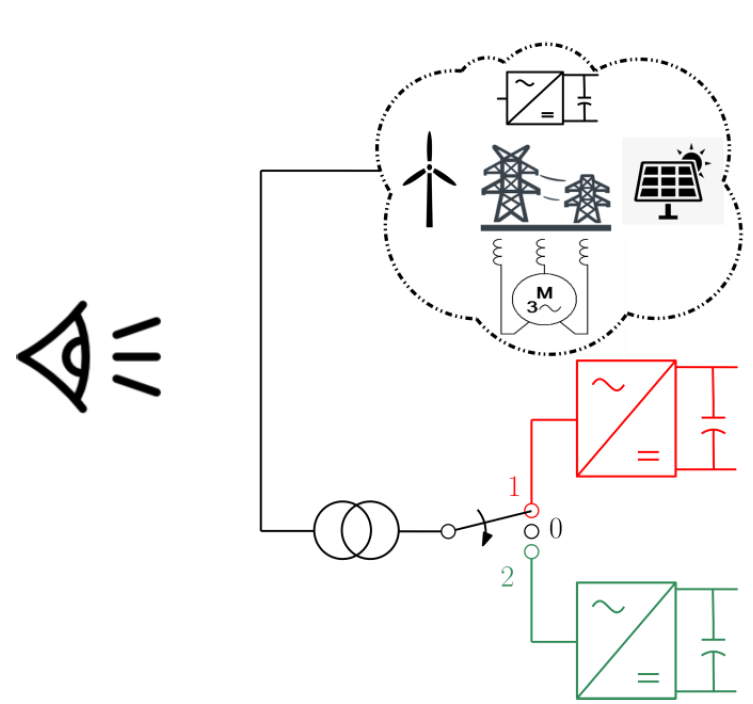
Figure 1 - Connection of a device to the existing power system with detrimental (red) or beneficial (green) effect
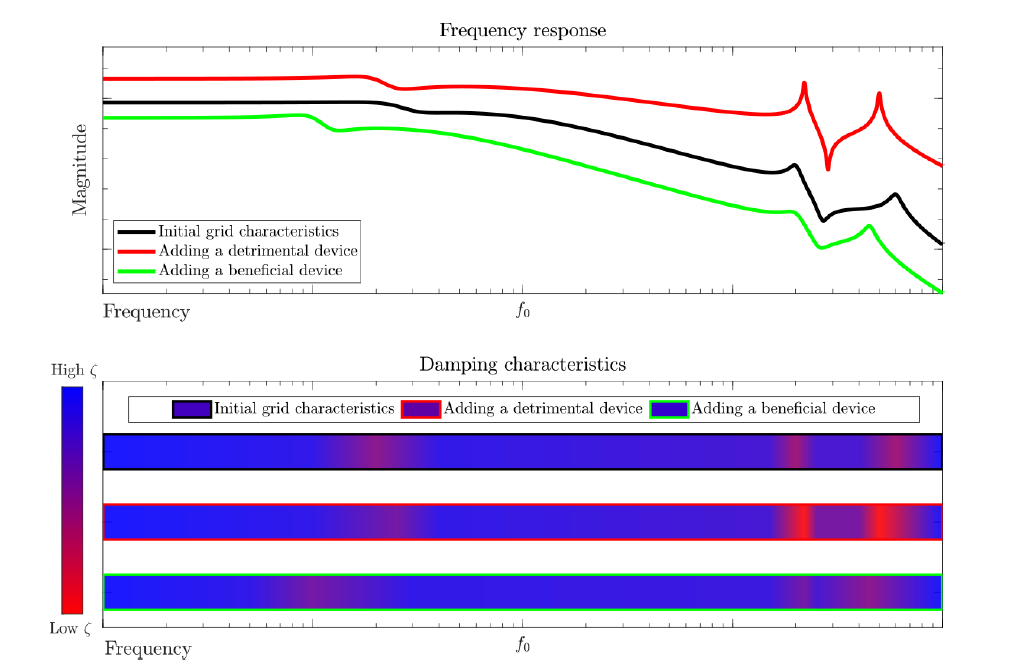
Figure 2 - High frequency damping modification example. Connecting a beneficial device (green curve) adds damping, whereas incorporating an inadequate device (red curve) decreases the damping with respect to the case without device (black), especially in the high frequency range (right side of the plot)
Conclusion
Power electronic converters are key enablers for the energy transition and integration of renewable energy sources in the power system. Their fast controllers are resulting in new types of instabilities at high frequencies where traditional power system equipment are not active. To ensure that converters do not deteriorate high frequency stability, future generations of converters should be designed so as to not contribute negatively to system damping at high frequencies ranges. In doing so, action can largely be taken locally, preventively and regardless of the uncertainty from future developments. Consequently, high frequency power system stability needs should to the maximum extent possible be addressed at component design stage before the task complexifies to an intractable level. As a power engineering community, we have to ensure that this can be achieved before it is too late.
References
- Z. Campbell, K. Andov, and S. Coppel, “AEP experience with sub-synchronous oscillation phenomena”, in: Proc. GT PRC, Atlanta, USA, 2018.
- Ørsted, “Ørsted technical report for national grid ESO on the events of 9 August 2019 (appendix of Ofgem technical report)”, Tech. rep., Ørsted, 2019.
- C. Li, “Unstable operation of photovoltaic inverter from field experiences”, IEEE Trans. Power Deliv. 33 (2), 1013–1015, 2018.
- S. Chen, “Analysis of HVDC convertor transformer core saturation instability, and design of a data acquisition system for its assessment”, Ph.d. thesis, University of Canterbury (Jan. 1996).
- D.Shu, X. Xie, H. Rao, X. Gao, Q. Jiang, and Y. Huang, “Sub- and super-synchronous interactions between STATCOMs and weak AC/DC transmissions with series compensations”, IEEE Trans. on Power Elec. 33 (9), 7424-7437, 2018.
- P. Kundur and N.J. Balu. “Power System Stability and Control”. EPRI Power System Engineering Series. McGraw-Hill, 1994.
- “White paper SSTI: Consideration of possible impacts of the operation of hvdc systems in the grid on the shaft trains of turbine-generator sets in power plants”, VGB Powertech, Tech. Rep., 2021.
- D. Ramasubramanian, W. Wang, P. Pourbeik, E. Farantatos, A. Gaikwad, S. Soni, and V. Chadliev, “Positive sequence voltage source converter mathematical model for use in low short circuit systems” IET Generation, Transmission & Distribution, 14 (1), 87–97, 2020.
- B. Badrzadeh, Z. Emin, E. Hillberg, D. Jacobson, L. H. Kocewiak, G. Lietz, F. M. Faria da Silva, and M. val Escudero, “The Need for Enhanced Power System Modelling Techniques and Simulation Tools”, CIGRE Science & Engineering, 17(February):30–46, 2020.
- M. Aeberhard, Zollikofen, M. Meyer, Wettingen, C. Courtois and Paris, “The new standard EN 50388-2, Part 2 – Stability and Harmonics”, 2014.
Thumbnail credit: Eduardo Drapier on Unsplash
Suggested content