Electricity markets and regulation
By Alex Cruickshank, Chair & Yannick Phulpin, Secretary
Introduction
Electricity Markets, like the objectives of the entities and systems that those markets serve, continue to evolve. Internationally, markets have developed and have successfully provided economic signals that support the development and operation of wholesale electricity. The success of those markets has allowed for the recognition, development and successful implementation of new technologies and solutions for supplying and purchasing electricity. This success has brought new demands on those markets. Market-based approaches have also been challenged by sudden changes in external factors (for example, the impacts of the energy transition, weather events and commodity prices).
Study Committee C5 is expanding its focus to report on and discuss the regulatory and market issues associated with the changing electric power industry, which include emerging technologies and services in generation, storage, transmission and distribution, and electricity demand management. SC C5 members provide needed insight to the wide variety of market and regulatory requirements involved with providing reliable energy with the changes in energy policy, technology development, consumer choice, and climate conditions.
Moreover, the changing landscape of behind-the-meter supply and the growing recognition for different levels of reliability and flexibility provides changes in industry requirements and consequent changes in market designs and regulations to properly incentivise the providers and consumers.
Scope of work
The scope of the Study Committee is to analyse
- the impacts on the planning and operation electric power systems of:
- different market approaches and solutions
- new structures, institutions, actors and stakeholders.
- The role of competition and regulation in improving end-to-end efficiency of the electric power system.
Structure of SC C5
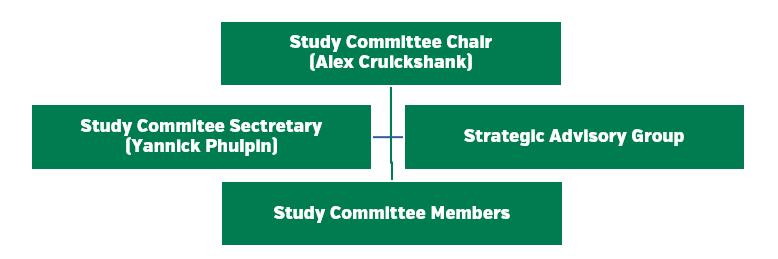
The structure of the Study Committee is shown below.
SC C5 membership
The current membership of the study committee is available on this page. The Study Committee has 24 ordinary members and 17 observers. Together, the members and observers represent 38 different countries.
WG Membership
The Working Group membership and demographics are examined in March of each year. The report for 2023 noted that the study committee had 6 Working Groups (6 at the time of this report). There were 118 members in the Working Groups. The WG members were spread across 31 countries. Our Working Groups had 14% female membership and a smattering of NGN members.
Principal areas of interest
The Study Committee focuses on three key areas
- Market structures and products: Market design, physical & financial markets and their interaction, isolated and interconnected systems, interactions with Hydrogen systems.
- Market approaches and tools: Demand & price forecasting, financial risk management, demand management and active customer integration, integration of blockchain technologies.
- Regulations: Regulatory objectives, regulatory approaches, transmission pricing, ancillary service pricing, reliability and economics).
In addition, the Study Committee is interested in:
- Changes in regulatory roles and jurisdiction related to the interaction between the transmission system and the distribution system.
- The role of markets, including: the integration and coordination of distributed energy resources; the impact on wholesale market price formation caused by non-wholesale market participants; the need for and development of distribution service providers.
- The impact of emerging technologies on system operations.
- Market clearing procedures, techniques and principles used to take advantage of the flexibility of aggregating large numbers of end-users.
- Potential market rule changes to address changes in traditional ancillary service products.
Areas of attention
The current areas of attention, which are reflected in the current Working Groups, are listed below.
Demand side developments and their integration into existing market structures
Innovative DR mechanisms and EV charge/discharge solutions have become a priority in the transition to low carbon energies. The WGs focus on the role of transmission system operators (TSOs) and distribution system operators (DSOs) in managing DR and EV services (e.g. operational time frames, service procurement mechanisms, payment methods, and activation of such services) and on the development of market-based approached for the management of these services (time frame, bid structure, and pricing mechanisms.)
- WG C5.31 - Wholesale and Retail Electricity Cost Impact of Flexible Demand Response
- WG C5.34 - Electric vehicle charge/discharge flexibility in wholesale energy markets
Market Drivers and development in markets
The purposes for market changes, the initiators of those changes, the processes for selecting a proposed change and the success of changes in meeting their objectives.
- JWG C5/C6.29 New Electricity Markets, Local Energy Communities
- JWG C5/C1.
Sector integration for renewable gas — primarily Hydrogen
Approaches to integrate Hydrogen solutions in electricity markets, particularly the development of markets and regulations relating to renewable hydrogens, and possibly related renewable gases.
- JWG C5/C1.35 - Integration of Hydrogen in Electricity Markets and Sector Regulation
Environmental Regulation in the Electricity Sector
A variety of regulatory or market-based approaches are implemented to manage environmental constraints, such as reductions in greenhouse gas emissions.
- JWG C5/C1.36 - Certification of electricity used to produce hydrogen
Sector regulation to support investment
Regulatory approaches to foster efficient investment in network assets.
- WG C5.37 - Regulatory framework on modernization and extension of useful life of transmission & distribution assets
2024 Cairns Symposium
Study Committee C5, together with SC C2 convened a symposium in Cairns, Australia. The symposium was hosted by the Australian National Committee of CIGRE. The symposium:
- was supported by 11 Study Committees. These were:
- A3 — Transmission and Distribution Equipment
- B1 — Insulated Cables
- B3 — Substations and electrical installations
- B5 — Protection and automation
- C1 — Power system development and economics
- C2 — Power system operation and control
- C4 — Power system technical performance
- C5 — Electricity markets and regulation
- C6 — Active distribution systems and distributed energy resources
- D1 — Materials and emerging test techniques
- D2 — Information systems and telecommunication
- attracted 243 papers, with 240 presented and discussed during the symposium. The authors were from 35 countries
- included 10 tutorials and 2 workshops
- had a record attendance of over 1,300 people with 40% from countries outside of Australia.
There were also 51 meetings in and around the Symposium, including a Technical Council meeting, Study Committee meetings, Advisory Group meetings and Working Group meetings.
Paper session
The Study Committee managed 4 sessions to discuss 18 papers on four themes:
- Australian markets
- Markets in other countries
- Issues and pricing of distributed generation
- Policy and strategy development, including energy transition plans.
Tutorials
The Study Committee organized one tutorial at the Cairns Symposium on hydrogen certification. The tutorial followed a general introduction to hydrogen and issues for the deployment of hydrogen. The tutorial focused on the work of the C5/C1 Working Group on hydrogen certification.
Topics of current and recent Working Groups
JWG C5/C6.29 - New Electricity Markets, Local Energy Communities
Today it becomes more and more efficient to develop local energy systems based on distributed energy resources (DER) allowing customers to become energy suppliers. Adding locally batteries to dispersed generators, stationary or within electric vehicles, allows for a group of citizens or more generally for any group of consumers, to settle their own local structure for their supply of electricity, becoming a local energy community (LEC). With the digitalization of economy and some specific tools such as block chain, each of this group may organize easily its local market. Depending on national regulation, LEC can or not own and/or operate the network, or even target to be physically balanced, enabling islanded operation. As underlined by the recent Clean Energy Package in the EU, regulation is under development for LEC.
This JWG will liaise with parallel JWG D2/C6.47 “Advanced Consumer-Side Energy-Resource Management Systems”.
WG C5.31 - Wholesale and Retail Electricity Cost Impact of Flexible Demand Response
The study aims to provide an international view of the connection between retail programs/rate structures to costs incurred in the provision of electric service that may be impacted by flexible demand response (DR). Demand response (DR) includes all forms of demand-side response, which refers to a change in load coordinated with system or market needs. The change in load behind the utility meter of the customer can stem from end-use equipment, storage, PV, and other forms of distributed generation.
The study also aims to analyse the methods applied in practice to either directly or indirectly reduce costs, by service territory, in both regulated and competitive market environments. Introductory background on the functions that flexible DR supports and how it is factored into system planning and/or operations will be addressed at a high-level to provide context for presentation of findings by service territory.
The study will also identify and clarify terminology, in order to assist data collection and presentation of findings with consistency to support ready comparison of findings across service territories.
WG C5.34 - Summary of current uses of electric vehicle charge/discharge flexibility in wholesale energy markets and reliable grid operations
This Working Group will summarize the current uses of Electric Vehicles and EV charging networks in the operations and market optimization of the wholesale power grid. The evaluation will summarize the locations, purposes/services/pricing, participant roles, requisite technology and requisite regulatory frameworks of current uses of EVs in wholesale grids. The final report will provide insight into both the common and bespoke elements of current integrations providing a framework for assessing potential future standardization of EV integration. The final report will also identify areas of need for future assessment for successful standardization of EV integration.
JWG C5/C1.35 - Integration of hydrogen in electricity markets and sector regulation
This Working Group will gather information about grid connection to hydrogen technology resources and new initiatives for analysing effect on electricity market such as Capacity Market, Day ahead Market as well as market coupling on Commodity market: Natural Gas price in Spot and Forward Market. In addition, this group will gather hydrogen related information and analyse regulation issues in various countries and continents which currently are established or are planned for the future.
JWG C5/C1.36 - Certification of the electricity used to produce hydrogen
The Working Group will recommend attributes that are considered to define hydrogen as green and will also structure the parameters that need to be certified so that it is possible to verify if hydrogen is green or if it has a greenhouse gas emission content.
WG C5.37 - Regulatory framework on modernization and extension of useful life of transmission & distribution assets
The WG aims to capture different regulations applied worldwide for modernization and extension of useful life of transmission assets, from generation to distribution connection points to assess how regulators balance the costs and benefits of augmentation and refurbishments for grid users.

CIGRE active Working Groups / Call for experts
Latest publications for 2022 and 2023
Tehnical Brochures
The Study Committee published two Technical Brochures:
Articles in CIGRE newsletters and Electra
In addition to the four Technical Brochure summaries, the Study committee contributed four articles for Future Connections and ELECTRA:
- A season of high electricity prices in Europe by Vincent Ringeissen, Christian Hewicker and Yannick Phulpin.
- Virtual Power Plants are leveraging Australian consumer investment in rooftop solar by Gabrielle Kuiper.
- Utility Scale Battery Storage in the Australian NEM by Jonathon Dyson
- Renewable gases to decarbonise the power system, by Alex Cruickshank, discussed the SC 5 work of JWGs C5/C1.35 and C5/C1.36. The first JWG is examining the role of Hydrogen in markets, while the second is examining how to certify that the Hydrogen is renewable.”

Pending Technical Brochures for 2023/24
Three Working Groups expect to complete their work and publish Technical Brochures in the coming 12 months:
- Wholesale and Retail Electricity Cost Impact of Flexible Demand Response
- New Electricity Markets, Local Energy Communities.
Pending Study Committee C5 meetings
- 2024 Paris, France – CIGRE Session, August
CIGRE Session 2022 Materials
SC C5 Package available on eCIGRE
Free for Members and Delegates
Contact
Suggested content