Information systems and telecommunication
by Victor Tan, Chair, and Joël Nouard, Secretary
Mission and scope
Mission
- To facilitate and promote the progress of engineering on Information & Communication Technology (ICT) for Electric Power Industries
- To publicize and promote state-of-the-art practices
Principal areas of interest
- Studying and considering the evolution of information and telecommunication technologies to cope with traditional and new requirements driven by the digital transformation in power industry including extension of Distributed Energy Resources
- Assessment of Technologies and architecture to assure business continuity and disaster recovery
- Overcoming security threats in the deployment of the networks of the future and especially in Smart Grids
Scope
Interoperability and data exchange
Between Electricity Network Grid Operators, System Operators, Market Operators, Generation Companies, Industrial Product Manufacturers, Telco Operators, ICT services providers, Energy Regulators, Certification Entities
Telecom network technologies and management
- Studying and considering telecommunication technologies and architecture evolution
- Assessment of technologies and architecture to ensure business continuity and disaster recovery
- Telecommunication network management when deploying new technologies and architectures
Implementation of the networks of the future
- Monitoring of experiences and proof of concepts of smart technologies Impact on the existing ICT systems such as telecommunication network and equipment
- SCADA, enterprise business functions (Smart Grid Architecture Model domain)
New digital trends used by EPU and new business services
- Monitoring on the field experiences on the deployment of digital equipment such as IEDs, PMUs, IoT, Fog and Cloud Computing, Network Function Virtualization, as well as the processing of large quantity of information (big data) in the domains of asset health, system operation, smart metering.
Cyber Security
- Assessment and promotion of best practices, tools, and solutions of cyber security from field equipment (protection) to corporate IT supporting the whole resilience strategy along the system life cycle: design, implementation, testing, operation, and maintenance.
- Cyber security challenges related to new devices, technologies and DER interconnection and the additional data exchanges between Transmission System Operators, Distribution System Operators and Significant Grid Users, as required by the flexibility management of future grids
Membership
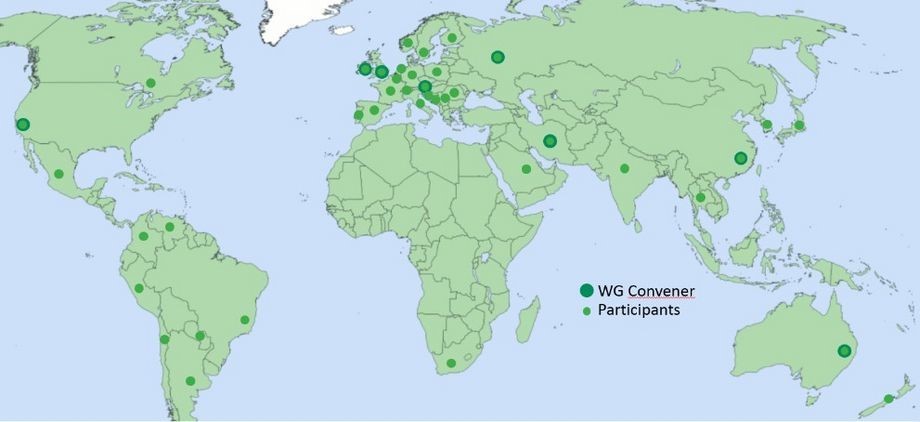
SC D2 consists of the 24 regular members, 5 additional regular members and 12 observer members representing overall 36 countries.
Advisory Groups
| Title | Convenor |
|---|---|
Core business information systems and services | Marcelo Costa de Araujo (BR) |
Cyber Security | Giovanna Dondossola (IT) |
Telecommunication networks, services and technology | Zwelandile Mbebe (ZA) |
Publications
This Technical Brochure provides an overview of Software Defined Networking (SDN) in the context of applications for power utilities.
The focus of this Technical Brochure is to inform the reader in the areas of SDN that are most applicable to power utilities; namely, SDN core concepts, Network Function Virtualisation (NFV) - where network functions such as routers and firewalls are virtualised, and a basic technical overview of the the technology. A deep and detailed description of the various technologies and protocols is not the intent of this Technical Brochure - as these are easily obtainable from other literature and sources. Rather, we aim to provide context and relevance of the areas most applicable to power utilities.
SDN is a large topic, where many different technologies are brought together and integrated as a solution to create a modern programmable and agile network. A subset of these core SDN technologies and protocols is described, along with references to the relevant standards and related works, which are summarised so that the reader can gain a basic level of appreciation of the numerous works that have been brought together to define SDN.
Time is growing to be an integral part of smart grid development. This brochure provides a reference document for time sources and time distribution in Protection, Automation and Control Systems (PACS) including recommendations and best practices. The brochure discusses the time sources and its distribution systems for PACS, and many fast-growing standards and technologies including IEC 61850, Precision Time Protocol, traveling wave-based applications, wide area measurement systems, etc. Many user cases, considerations, and recommendations for building robust timing systems are summarized in the report.
Article in Future Connections Newsletter
D2 published two articles in Future Connections Newsletter and ELECTRA:
- #8 “Application of 5G Technology to Smart Grids” by WG D2.55 Convener Kunlun Gao (CN) and Yi Wang (CN)
- #9 “Interdependence and Security of Cyber-Physical Power System” by Qinglai Guo (CN), WG D2.56 Convener, and Luo Xu (CN), WG D2.56 Secretary
Article in ELECTRA
- Article based on the results of AG D2.03 "Survey on the current state of telecommunications in power utilities" by Victor Tan (AU) (Convenor), Jaume Darne (ES), Zwelandile Mbebe (ZA), Louise Watts (AU), Marcelo Costa de Araujo (BR), Karen McGeough (IE), Jasmina Mandic Lukic (RS), Mehrdad Mesbah (FR)
- Article "An open-source driven transformation in the power industry" by Lucian Balea (R&D Program Director and open source manager, RTE), Benoît Jeanson (Open Source Enterprise Architect, RTE), Arjan Stam (Director of System Operations, Alliander)

CIGRE Paris Session 2022
SC D2 session included four majors and very successful events.
Workshop
“Standardization of Cybersecurity in power utilities digital infrastructures – a joint vision from IEC, IEEE and CIGRE”
The workshop was moderate by Giovanna Dondossola (IT) with the participation of Olga Sinenko; Victor Tan; Steffen Fries; Herbert Falk; Frances Cleveland; Govindarasu Manimaran; Marc Lacroix; Vetrivel Subramaniam Rajkumar; Johan Malmstrom; Miguel Sánchez Rodríguez.
The joint workshop has been contributed by internationally recognized experts involved in the development of IEC, ISA/IEC and IEEE standards and guidelines.
It overviewed core requirements and solutions standards in the cybersecurity suite covering technologies, processes, and people, by emphasising their respective role and complementarity.
Sample applications of such standards to the power substation environment have been also contributed by some CIGRE 2022 papers.
More than 120 people attended the workshop.
Poster Session
Moderate by Vitor Meneguim (FR), where 34 posters were presented to almost 300 people.
Group discussion meeting
Including three Preferential Subjects:
- PS1: The opportunities and challenges brought by emerging Information and Communication Technologies to Electric Power Utilities in their path to Digital Transformation
- PS2: Cybersecurity techniques, technologies and applications for securing critical utility assets
- PS3: Meeting the demands of the modern utility and DER with an agile and resilient telecommunication network
CIGRE Session 2022 Materials
SC D2 Package available on eCIGRE
Free for Members and Delegates
Awards
The following SC D2 members received CIGRE awards in 2022:
- Olga Sinenko (RU) was awarded CIGRE Honorary Member after being SCD2 Chair from 2018 to 2022;
- Gustavo Arroyo-Figueroa (MX) was awarded CIGRE Technical Council Award.
Active Working Groups
The total number of Working Groups at the end of 2022 was 15, gathering more than 200 experts from 40 countries. New Working Groups, launched in 2022, are:
- WG D2.56 - Interdependence and Security of Cyber-Physical Power System
- JWG A2/D2.65 - Transformer Digital Twin – concept and future perspectives
- JWG B3/D2.62 - Life-long Supervision and Management of Substations by use of Sensors, Mobile Devices, Information and Communication Technologies
- WG D2.57 - CIM (Common Information Model) Methodology
SC D2 members and experts’ global diversity
As a transverse Study Committee, D2 aims at collaborating with other SCs whenever it seems useful.
Core and Business Systems
- JWG D2/C6.47 – Advanced Consumer Side Energy Resource Management Systems
- JWG D2/C2.48 - EnhancedInformation and Data Exchange to enable Future Transmission and Distribution Interoperability
- JWG B2/D2.72 - ConditionMonitoring and Remote Sensing ofOverhead Lines
- WG D2.49 - Augmented reality / Virtual reality to support Operation and Maintenance In Electric Power Utilities
- WG D2.52 - AI Application and Technology on Power Industry
- WG D2.53 - Technology and Applications of Internet of Things in Power Systems
- WG D2.56 - Interdependence and Security of Cyber-Physical Power System
- JWG A2/D2.65 - Transformer Digital Twin – concept and future perspectives
- JWG B3/D2.62 - Life-long Supervision and Management of Substations by use of Sensors, Mobile Devices, Information and Communication Technologies
- WG D2.57 - CIM (Common Information Model) Methodology
Cyber Security
- WG D2.45 - Impact of governance regulations and constraints on EPU sensitive data distribution and location of data storage
- WG D2.51 - Implementation of SOC in EPI as Part of Situational Awareness System
- WG D2.54 - Regulatory approaches to enhance EPU’s cybersecurity frameworks
- Plus: Active link with IEC TC57 WG15, on IEC 62351
Telecommunication infrastructures or services
- WG D2.44 - Usage of public or private wireless communication infrastructures for monitoring and maintenance of grid assets and facilities
- WG D2.55 - Application of 5G Technology to Smart Grids

CIGRE active Working Groups / Call for experts
Future activities
Symposium “The End-to-End electricity System: transition, development, operation and integration”, 4-7 September 2023, Cairns (AU). Participating SCs: A3, B1, B3, B5, C1, C2, C4, C5, C6, D1 and D2.
Conclusion
2022 has seen an acceleration of energy transition, which has resulted in new challenges and complexities in the global effort to engineer an orderly transition. SC D2 considers information systems as critical components in bringing efficiency, reducing risks, and lowering costs in meeting the demands of an increasingly agile grid required by the adoption of renewables.
New areas of applications such as machine learning, inspection drones and cloud computing are bringing operational efficiency and safety to power utilities.
We continue to see foundational technologies being improved and upgraded to maintain and increase the resilience of utilities – these include transitioniong from legacy telecommunication networks to packet-based networks and adoption of existing and new wireless technologies such as Low-power Wide-Area Network and 5G.
Cybersecurity has seen an increased activity and development in policy, technical controls and regulation in power utilities. CIGRE, along with other partnering organisations including IEC and IEEE, have increased effort in the development of best practices, standards and use cases in the rapidly changing cybersecurity landscape, and will continue to do so to inform and protect power utilties worldwide.
The power utility information systems, cybersecurity and networks are increasingly integrated and inter-related, both internally within the utility and with other power market participants. SC D2 will continue on the development of these topics to assist power utilities in navigating these opportunities and challenges.
Contact
Suggested content